


What sort of people dream of a country with no soldiers?
Plato’s Laws opens near that question. In its first book, a Cretan named Cleinias explains that the lawgiver of Crete ordained common meals, gymnastic training and the bearing of arms with war in view. What men call peace, he says, is “only a name; in reality every city is in a natural state of war with every other, not indeed proclaimed by heralds, but everlasting.”
The Athenian Stranger, the dialogue’s chief speaker, corrects him on the order of things. He says peace and goodwill are best, and a sound legislator makes war for the sake of peace, never peace for the sake of war. The correction concerns the purpose of arms. Later in the same dialogue, the Athenian proposes that citizens practise war while they are at peace and that every sensible city take the field at least one day in every month, “having no regard to winter cold or summer heat.”
Soldiers hold a high place in the Republic as well. There, Socrates builds a city in speech. Plato’s brother Glaucon mocks its first, frugal version as a city fit for pigs. Once the citizens want couches, perfumes and delicacies, they need more land, and the land they want belongs to their neighbours. Socrates traces war to that appetite. The enlarged city therefore needs a class of guardians who do nothing but defend it, and he compares them to well-bred watchdogs, fierce toward strangers and gentle toward those they know. Later in the dialogue he chooses the city’s rulers from among these guardians, and the rest serve as their auxiliaries.
Twenty-four centuries later, the logic holds. Those who dream of societies without soldiers are delusional about human nature and the predatory nature of empires. Russian columns crossed into Ukraine on Feb. 24, 2022, to settle the matter for anyone still unsure. Not because Russia is ruled by monsters, but because humans rule it.
Many have kept the false dream. Anarchists imagine order without anyone to enforce it. Pacifists mistake the absence of fighting for peace. The communist regimes of the last century financed and preached disarmament to Western audiences while fielding the largest armies on earth. Each pictures a world that needs no peace enforcers and no defenders, and each depends on someone else’s soldiers to keep that picture intact.
In Canada, the dream found a governing party. Pierre Trudeau came to office in 1968, having opposed, as a young official in the Privy Council Office, Canadian participation in the Korean War and the deployment of Canadian troops to Europe after 1951. He considered withdrawing Canada from NATO altogether. On April 3, 1969, he settled instead for a “planned and phased reduction” of Canadian forces in Europe. His government later halved the contingent from 10,000 to 5,000 and ended its nuclear-strike role. Over the following decade, total force strength fell from more than 100,000 to 78,000. In 1969, Trudeau told his cabinet that Canada’s military establishment was “determined not to impress our enemies but rather to impress our friends.”
His son carried the misguided inheritance forward. In April 2023, a leaked Pentagon assessment reported by the Washington Post stated that Justin Trudeau had told NATO officials privately that Canada would never reach the alliance’s target of two per cent of GDP on defence. In 2024, his own defence minister, Bill Blair, described the Canadian Armed Forces as caught in a personnel “death spiral.”
Mark Carney presents a harder case. On June 9, 2025, he announced that Canada would reach the two per cent target within the fiscal year, and his government declared the target met on March 26, 2026. He has committed Canada to NATO’s new goal of five per cent by 2035. On Feb. 17, 2026, he launched a Defence Industrial Strategy promising $180 billion in procurement and $290 billion in defence and security infrastructure over a decade. Though no one knows where the money will come from, Carney’s statement declaring the target met called the Canadian Armed Forces “the foundation of the strength on which we are building Canada strong and free.”
Plato would recognize the sentence. He would also ask what stands behind it.
Real money did reach the forces, mostly in pay, equipment and operations, and Carney earns credit for it. Less of it arrived than the headline claims. Ottawa reported $65.9 billion in defence spending to NATO for 2025-26, about $22 billion more than the year before. National Defence’s own forecast for the armed forces, leaving aside the Coast Guard, comes to $44.6 billion, or roughly 1.4 per cent of the economy. Carney’s government closed much of the gap by redrawing the line around the word defence.
The Coast Guard, a civilian service the military’s vice-chief says will not be armed, moved into the defence portfolio on Sept. 2, 2025, and its entire budget now counts, where two-thirds counted before. Veterans Affairs says all its expenditures, including pain and suffering compensation, now count toward the NATO target. Internal records obtained by Blacklock’s Reporter list a $7.13-million grant to Hydro Ottawa, a water treatment plant in Saguenay, a humanities research grant and some 14,450 trees planted around military housing. Why not count the Girl Guides?
Stefanie Beck, who retired as deputy minister of National Defence in January, warned days later that the new money was “nowhere near what we need” and would only “plug in the holes in the wrong way.” On April 20, 2026, Deputy Auditor General Andrew Hayes told MPs that of the tens of thousands of people who applied to join the Forces between 2022 and 2025, only one in 13 ever reached basic training. Canadians have too many couches and too many PlayStations.
Then came Military Personnel Instruction 03/26, issued July 29, 2026, under Carney’s government. The instruction bars chaplains from offering faith-specific prayer at official ceremonies members are expected to attend, including Remembrance Day, and extends the duty to respect it to every member of the Forces. Regimental prayers may be taught as unit history but may not be said during a ceremony. Indigenous practices containing spiritual elements, by contrast, may enter military settings for cultural and educational purposes, and the Department of National Defence justified that allowance by citing the Truth and Reconciliation Commission’s Calls to Action.
I argued in August that this rewrite of a national rite arrived by command, without a word from Parliament. The asymmetry carries the larger lesson. The anti-colonial ideology of the past decade treats one inheritance as a Charter hazard and another as a reconciliation asset, and the Forces now carry that self-loathing into their own ceremonies. The prayer interdiction belongs on the same shelf as the tampon dispensers that appeared in the men’s washrooms of Canadian Forces bases after Dec. 15, 2023, under a Canada Labour Code rule the Trudeau government imposed on every federally regulated workplace. National Defence defended the dispensers in the language of inclusion.
(More below)
Haultain Research is a reader-supported publication. To receive new posts and support our work, consider becoming a free or paid subscriber. You may also support us by sharing our work with like-minded friends and family, or making a modest donation at www.haultain.org
A government can buy frigates. No budget can buy the conviction that the country is worth a frigate. Soldiers come from families, schools and towns that teach them their country carries something worth keeping: a constitution, a faith, a history, a way of life. When the state that recruits them speaks of that inheritance mainly as an embarrassment, a genocidal state, a society confused about biology and reality, it sends a message no pay raise can cancel.
Canadians, for their part, keep answering the call. Defence Minister David McGuinty reported on April 20, 2026, that the Forces had received more than 44,000 applications to the Regular Force over the previous year, 62 per cent more than the year before, and had enrolled 7,310 new members, the highest intake in three decades. Crowds still stand at cenotaphs in the November cold. The ethos lives among citizens. The legislators and institutions that command it lag behind, and we can only hope they will turn around.
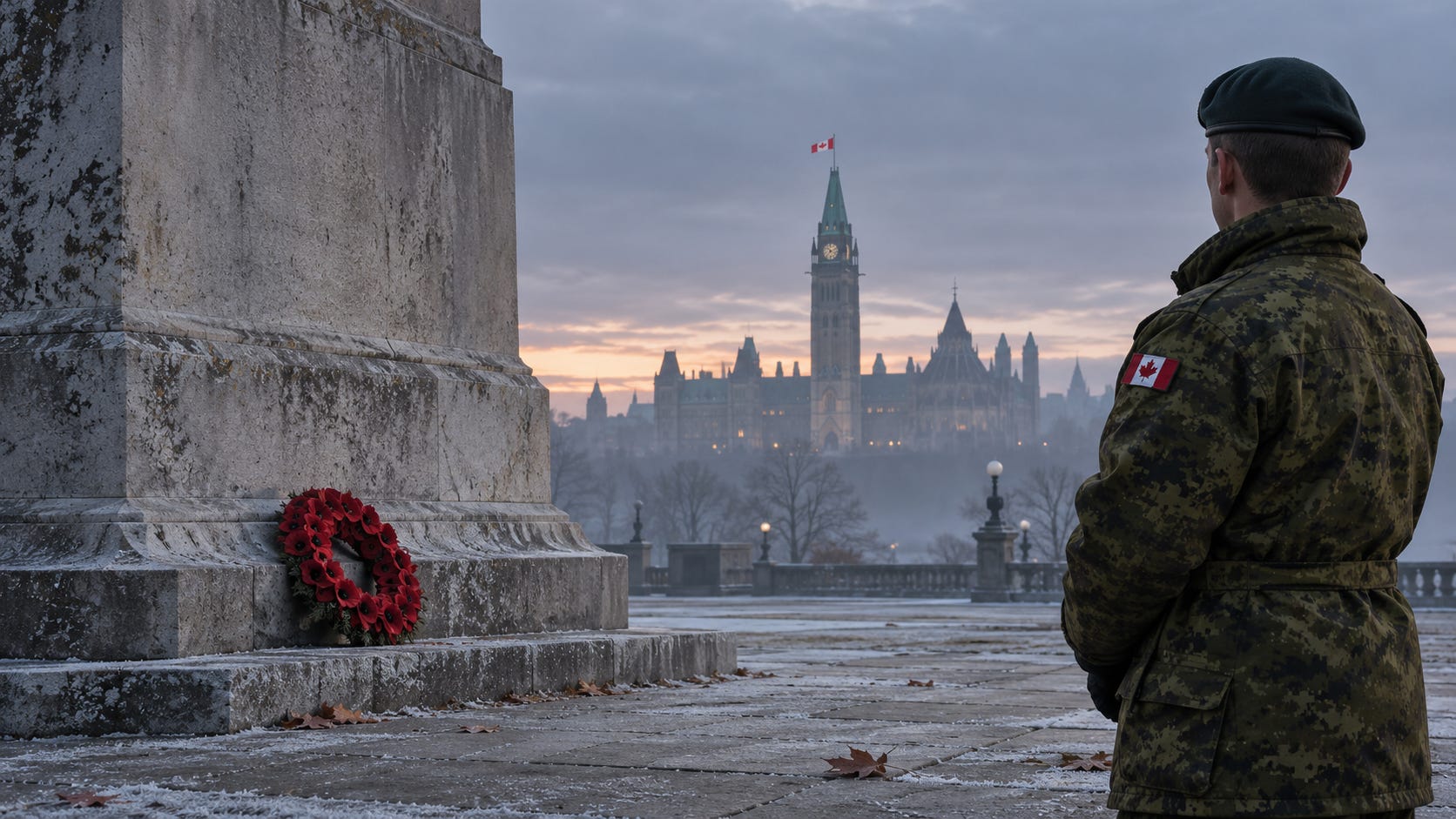
On Nov. 11, Canadians will hear the Last Post and keep two minutes of silence. Remembrance honours the dead. A culture of defence prepares the living, and for much of the past half century Canada has let the second wither while performing the first.
In the Menexenus, Socrates recites a funeral oration for the Athenian war dead, which he attributes to Aspasia. After recounting their deeds, it turns to the living: “let every man remind their descendants that they also are soldiers who must not desert the ranks of their ancestors, or from cowardice fall behind.”
What sort of people dream of a country without soldiers? People who have stopped believing their country is worth keeping.
Beyond Remembrance Day, Canada needs to retrieve a culture that values its defence because it values itself and its own preservation.
Thank you for a heartfelt and meaningful article.