


From December 2025 to September 2026, Alberta added 53,500 jobs, a gain of 2.0 per cent. Canada as a whole lost 41,200 over the same nine months. Take Alberta out, and the rest of the country lost 94,700 jobs, a decline of half a per cent.
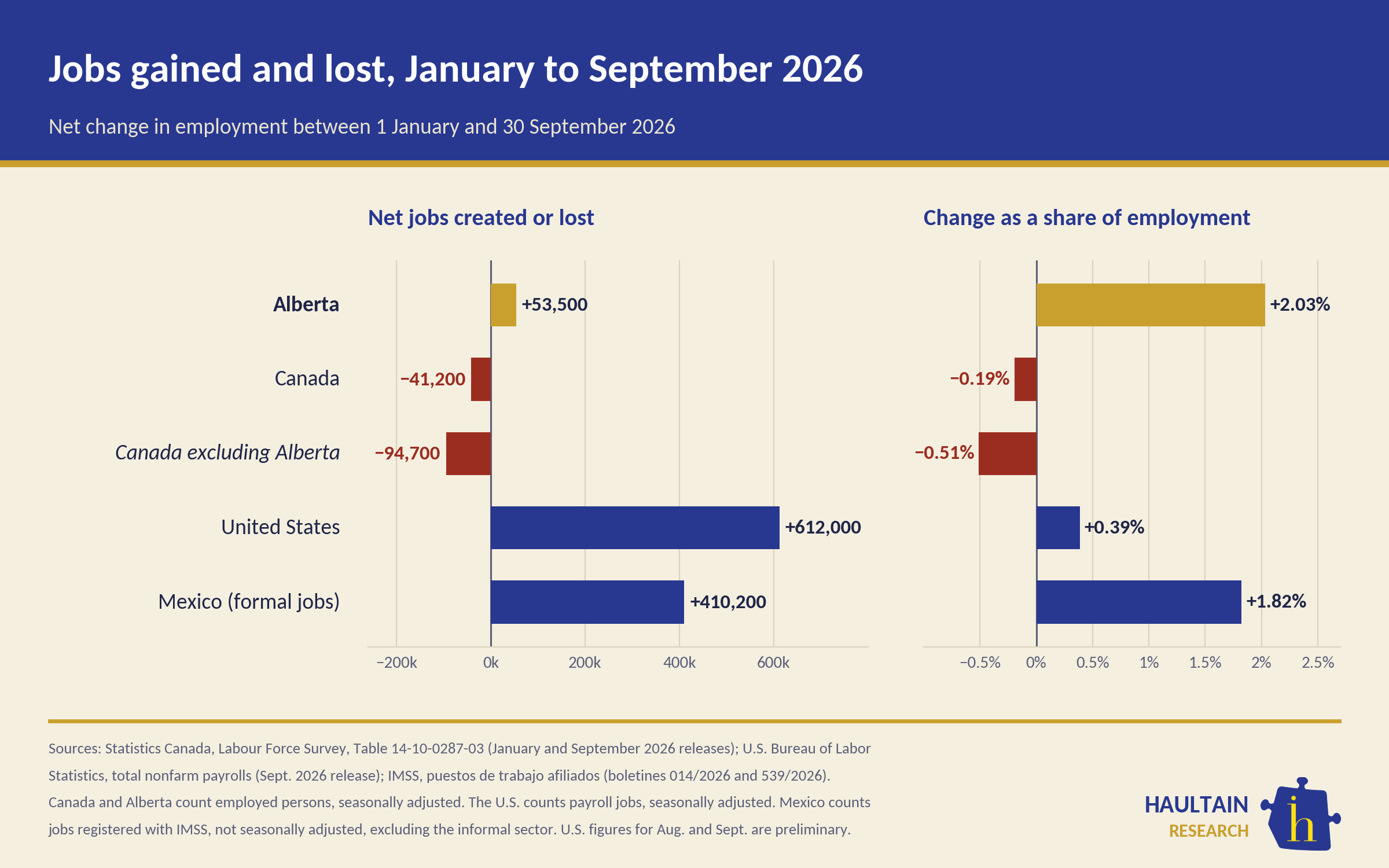
The chart sets those numbers beside Canada’s two continental partners. The United States added 612,000 payroll jobs, an increase of 0.4 per cent on a base of 158 million. Mexico’s formal economy added 410,200 jobs registered with its social security institute, a rise of 1.8 per cent. In proportional terms, Alberta’s employment grew about five times as fast as American payrolls and slightly faster than Mexico’s formal workforce.
The divergence inside Canada is the more telling result. Alberta holds about one Canadian job in eight, yet it added 53,500 while the other nine provinces together lost 94,700. Quebec accounted for much of the decline, losing 126,700 jobs since December (but people insist on comparing the two). In September alone, national employment fell by 68,000, and public-sector employment fell by 70,000 (the best news here), its fourth consecutive monthly decline. Over the same nine months, Alberta’s unemployment rate fell from 6.7 to 6.4 per cent.
Readers should weigh the Canadian figures with some care. The Labour Force Survey is a sample, and Statistics Canada publishes a standard error of about 32,000 for the national employment estimate. A net decline of 41,200 is modest against that margin, so the national picture is best described as flat to slightly down. Alberta’s gain is roughly four times its own standard error of about 13,000 and stands well clear of sampling noise.
The three countries count employment differently. Statistics Canada counts employed persons through a household survey. The American Bureau of Labor Statistics counts jobs on employer payrolls, so a worker with two jobs appears twice. Mexico’s Instituto Mexicano del Seguro Social counts positions registered for social security. Its figures are not seasonally adjusted and exclude the informal sector, which employed 55 per cent of Mexican workers in August, according to the national statistics agency, INEGI. Part of Mexico’s gain also reflects the usual recovery from December, when registrations fall every year. The comparison across countries is therefore indicative rather than exact; the comparison within Canada uses one survey and one method throughout.
American momentum has slowed. The economy added only 29,000 jobs in September, and August was revised down to 133,000. Both figures are preliminary and will change. Over the nine months, American payroll growth averaged about 68,000 a month.
Alberta’s result extends a pattern now several years old. From 2022 to 2025, employment in Alberta grew nearly 10 per cent against 6.5 per cent nationally, according to the Business Council of Alberta’s analysis of Labour Force Survey data. In the twelve months to September, Alberta added 75,700 jobs, a gain of 2.9 per cent, while Canada as a whole added 95,000, a gain of 0.5 per cent. A province with one job in eight produced about four of every five net new jobs in the country. This year’s numbers sharpen a question Albertans are already weighing: how much the province contributes to a federation whose other members are, for now, losing ground.
Sources: Statistics Canada, Labour Force Survey, Table 14-10-0287-03; U.S. Bureau of Labour Statistics, Current Employment Statistics; IMSS, Boletines 014/2026 and 539/2026; INEGI, ENOE, August 2026; Business Council of Alberta, “Alberta job growth drivers” (2026).
Haultain Research is a reader-supported publication. To receive new posts and support our work, consider becoming a free or paid subscriber. You may also support us by sharing our work with like-minded friends and family, or making a modest donation at www.haultain.org