


Most of our state institutions are worth defending, but they are not perfect, and sometimes the people who populate them fall well short of expectations. When they do, the electors are justified in keeping the elected on a tight leash. In Alberta, that reflex is Wednesday.
Twenty-five days before Albertans vote on ten referendum questions, Ken Boessenkool posted a two-sentence note on Substack. “Direct democracy is for losers,” he wrote, adding that Alberta had been demonstrating as much “in spades.” The note promoted an essay he co-wrote with Jared Wesley, a political scientist at the University of Alberta, which The Line published on September 24 under the heading “Direct democracy was better in theory than practice.” The Line ran it as part of a partnership with Lead Not Leave, a campaign wishing to keep Alberta in Canada. The essay argues that Alberta should reverse its recent moves toward referendums, recall and citizen initiatives, and return discretion to legislators, officials and party insiders.
Who, exactly, are the losers?
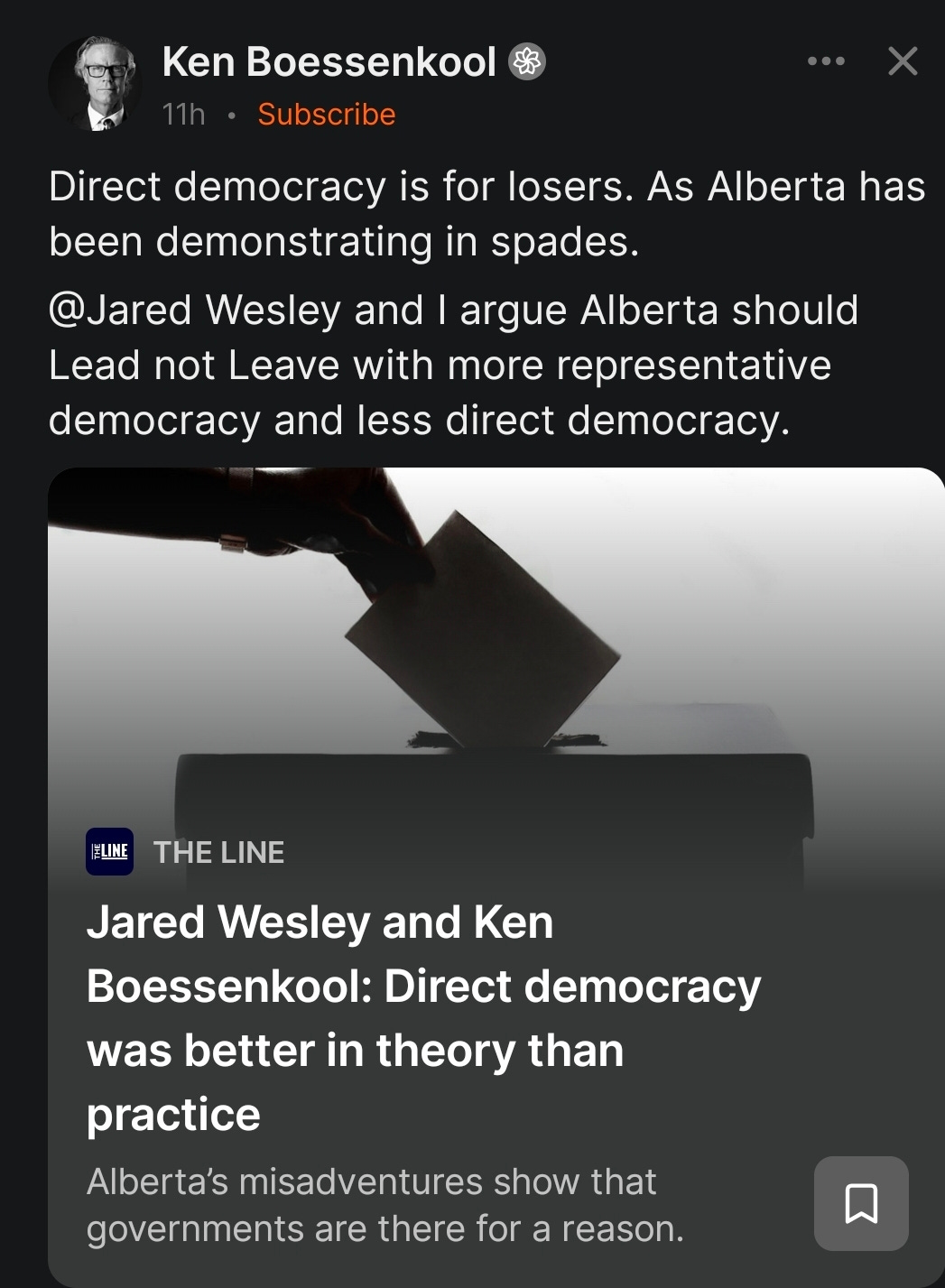
Boessenkool’s note answers more candidly than the essay does. Read charitably, he means that direct democracy is the recourse of those who lose in the legislature. Read plainly, he means that those who use it are losers. Either reading exposes the premise on which the whole essay rests: citizens who turn to the ballot between general elections are a problem for democracy to manage, not participants in it.
A realistic grasp of Alberta political culture is missing in so much pundit commentary and formal scholarship.
Wesley and Boessenkool rest their case on three objections to direct democracy: scale, complexity and stability. The first holds that governments make thousands of decisions a day, too many for voters to weigh without gridlock or fatigue. The second holds that subjects such as cybersecurity regulation and monetary policy demand expertise no ordinary voter possesses. The third holds that referendums invite majority tyranny and force polarizing binary choices.
Applying these objections to Alberta, the authors argue that the five immigration and election questions deny nuance and marginalize those affected, that the four constitutional questions are redundant because the government already holds a mandate and cannot amend the Constitution alone, that recall campaigns have produced only theatre, and that none of the ten questions arose from a properly conducted citizen initiative. Their remedies are higher thresholds for initiatives, narrower or repealed recall, referendums confined to matters within provincial authority or already commanding broad national consensus, stricter rules on who may run for and choose party leaders, delegated leadership conventions, and more resources for MLAs. A return to smoky backrooms, they add, would arguably improve on present practice.
The first visible difficulty lies in the argument’s structure. The authors concede that nobody has proposed Alberta abandon representative government for direct democracy, yet their three objections apply only to such a replacement. Ten questions on one ballot hardly strain voters' attention, so the scale objection misses its target. The complexity objection misses too, since it attacks the idea of voters administering monetary policy, which no question on the ballot asks them to do; each question asks whether the government should pursue a direction and leaves implementation to legislators and officials. In effect, the authors defend ground nobody contests and then claim ground they have not defended.
The complexity objection also proves too much. If voters cannot grasp how complex policies interact, they cannot judge a party platform either, and a platform bundles hundreds of such policies into a single choice every four years. The argument supplies no principle that stops before it reaches general elections. The stability objection suffers from a similar blind spot, because the majoritarian danger it describes lives at least as comfortably in the legislature the authors prefer.
A Westminster majority concentrates power far more than a referendum does, and whatever either one produces must still survive the Charter. As for the fear that majorities will turn on minorities at the ballot box, the research is mixed: Barbara Gamble found civil-rights restrictions passing at high rates in American initiatives, while Zoltan Hajnal, Elisabeth Gerber and Hugh Louch found California’s minorities on the winning side of ballot propositions about as often as white voters. The authors assert a harm that the evidence leaves unsettled.
When the authors turn from theory to Alberta, their argument begins to strain against itself. They write that the government made its intentions clear on most of the constitutional items during the last election campaign and therefore already holds a democratic mandate for them. They also write that the premier’s office came up with the ten questions on its own, without an electoral democratic mandate. Both statements don't apply to the constitutional questions on which the government campaigned, and the authors never say which questions they believe lack a mandate.
Their complaint that a referendum on immigration relieves government of its duty to engage those affected overlooks where the questions came from. The government-appointed Alberta Next Panel held town halls across the province through 2025, and the questions drew largely on its recommendations. One may judge that consultation inadequate, but one cannot say it did not occur.
The same habit of assertion appears in their claim that none of the ten questions resulted from a properly conducted citizen initiative, a claim that rests entirely on the word “properly.” Elections Alberta verified Thomas Lukaszuk’s Forever Canadian petition, asking whether Alberta should remain in Canada, in December 2025 with 404,293 signatures after statistical sampling, well above the 293,976 required. When the legislative committee recommended a referendum, government members pointed to Lukaszuk’s own application, which selected that route, and the first option on the tenth question tracks his petition. A rival separatist petition had 222,597 verified signatures in July 2026, with further steps stayed pending an appeal. Their qualifier thus excludes every counterexample in advance.
Recall receives the same treatment. The authors cite the failure of more than a dozen recall campaigns as proof that the mechanism is flawed. The record, however, supports the opposite conclusion. Since 2025, a recall petition must gather signatures equal to 60 per cent of the votes cast in the MLA’s riding at the last election. The campaign against Indigenous Relations Minister Rajan Sawhney gathered roughly 3,400 of the nearly 15,000 signatures it needed, and most petitions targeted government members, the premier among them. A threshold that screens out campaigns lacking broad support is a safeguard working as designed.
Two further moves rely on labels. The authors write that the first five questions target immigrants, yet one of the five concerns proof of citizenship to vote. The first asks whether Alberta should take greater control of immigration to reduce it to more sustainable levels, prioritize economic migrants and give Albertans priority for new jobs. On that point the authors stand apart from their fellow citizens, since most Canadians now tell pollsters that the country admits too many immigrants.
Calling the question’s supporters anti-immigrant substitutes a characterization for an argument, as I have argued at greater length in An Immigrant Reads the Immigration Questions and Name It Accurately, and the Binary Dissolves. The authors then suggest that voters drawn out by these questions will also vote on the tenth, on separation, and leave it to readers “to interpret the alignment of such voters.” The sentence makes an accusation while declining responsibility.
The authors do have a point buried beneath the labels. The first question bundles three distinct policies into a single yes or no, and a voter who favours one and opposes another has no way to say so. That defect argues for better question drafting. It gives no reason for fewer of them.
The constitutional objection reveals the largest gap. The authors note that Alberta cannot amend the Constitution alone. That is true, and beside the point. In the case of secession, the Court held that a clear majority on a clear question would oblige the other participants in Confederation to negotiate. More broadly, it found that each participant’s right to initiate constitutional change imposes a duty on the others to engage in constitutional discussions that address democratic expressions of a desire for change, and it recognized a referendum as a democratic way of ascertaining the electorate’s views.
Boessenkool knows this better than most. The 2001 firewall letter he co-signed with Stephen Harper, Tom Flanagan, Ted Morton, Rainer Knopff and Andy Crooks read the Court’s reasoning to mean that Ottawa and the provinces must seriously consider constitutional reform endorsed by a clear majority on a clear question in a provincial referendum, and it urged Premier Ralph Klein to use one to press Senate reform. Under the rule Wesley and Boessenkool now propose, confining referendums to constitutional matters already commanding broad national consensus, the referendum the firewall letter recommended would have been forbidden.
Boessenkool has at least been consistent in his scepticism of symbolic referendums. In 2023 he called Alberta’s equalization referendum dumb and argued it could only detract from the government’s mandate in dealing with Ottawa. Opposing a particular referendum as unwise is defensible. Proposing to foreclose the instrument is a different position, and he has not reconciled the two.
Haultain Research is a reader-supported publication. To receive new posts and support our work, consider becoming a free or paid subscriber. You may also support us by sharing our work with like-minded friends and family, or making a modest donation at www.haultain.org
Beneath these specific errors lies a misunderstanding of democracy and of Alberta’s political culture. Democracy is, in a precise sense, for losers. The political scientist Adam Przeworski defined it as a system in which parties lose elections. Comparative research on “losers’ consent,” led by Christopher Anderson and his colleagues, finds that a democracy’s stability depends less on how winners behave than on whether losers accept outcomes and believe they retain a lawful path to prevail later. Recall, initiative and referendum are such paths. Closing them leaves the losing side intact and informs it that its remaining channels lie outside the institutions.
The Boesessenkool and Wesley essay also confuses a theory of administration with a theory of legitimacy. Its objections from scale and complexity ask who is best equipped to make policy, a sound question for designing a public service. Democracy answers a prior question: by what right does anyone govern? Representative institutions borrow their authority from the governed.
That distinction explains why the model Wesley and Boessenkool describe owes more to Joseph Schumpeter than to Edmund Burke. Schumpeter held that voters choose their leaders and then leave political action to them; between elections, he wrote, voters “must refrain from instructing him about what he is to do.” Recall and initiative are precisely the instructions the authors want to curtail. Burke’s trustee, whom the authors invoke when they describe MLAs as trustees of the broader public good, held discretion because he held trust. Burke told his Bristol electors in 1774 that he owed them his judgment. They declined to return him in 1780. Trusteeship has always depended on voters keeping a remedy.
That remedy matters most when trust is scarce, and trust is scarce. Statistics Canada’s Canadian Social Survey found that 28 per cent of Canadians reported high confidence in Parliament in the fall of 2023, and 37 per cent in the Canadian media. High confidence in the school system fell from about 51 per cent in 2022 to 45 per cent by the end of 2024, and by late 2024 four in 10 Canadians rated their confidence in Parliament at one or two out of five. Albertans led the decline before anyone had heard of COVID-19. Proof Strategies’ 2019 trust survey found Alberta driving a national drop in trust, which the firm’s chair attributed to Albertans watching their economic opportunity foiled by Ottawa.
Even these figures likely understate the problem. People who distrust institutions are less likely to answer surveys commissioned by those institutions or their allies, so measures of trust carry a built-in upward bias that grows as distrust grows. The decline shows through regardless: the federal board that certifies subsidized newsrooms acknowledges that trust in news continues to decline year after year. Conduct, however, is a sturdier witness than stated opinion, and conduct points the same way. Albertans put more than 626,000 verified signatures on two rival petitions about the province’s future, a count of signatures rather than of distinct people, since one person could sign both.
Why did trust fall? The legal philosopher Lon Fuller argued that law commands allegiance when the rules as announced match the conduct of those who administer them. Citizens withdraw trust when they watch that congruence fail, and the recent Canadian record has given them ample occasion.
The pandemic supplied the densest record. In Ingram v. Alberta, Justice Barbara Romaine found in 2023 that Alberta’s public health orders exceeded the authority of the Public Health Act because cabinet, rather than the Chief Medical Officer of Health, made the final decisions. The public had been told it was following medical expertise. The statute assigned the decision to an expert. Ministers took it. The same judgment upheld the infringements of Charter rights as reasonable limits, although the government produced no comprehensive study of lockdown harms. Courts across the country followed that pattern: they policed which official signed an order and rarely asked whether it should have been signed.
In January 2026 the Federal Court of Appeal confirmed that the federal government’s 2022 invocation of the Emergencies Act was unreasonable, exceeded its legal authority and infringed the Charter. Prime Minister Mark Carney’s government appealed to the Supreme Court in March. The Auditor General, meanwhile, found $4.6 billion in pandemic benefit overpayments to ineligible recipients and at least $27.4 billion more that warranted investigation, and could only estimate the cost of the ArriveCAN app at $59.5 million because the records were so poor.
Albertans also learned during those months what a public commitment was worth. In July 2021, Premier Jason Kenney declared that Alberta would neither facilitate nor accept vaccine passports, which he said would in principle contravene the province’s health-information and privacy laws. Several weeks later, his government introduced proof of vaccination under another name, the restrictions exemption program.
The incongruence reaches beyond emergencies. Governments across the country have written “gender identity” into human rights law. Governments across the country have joined in and often use the power of law to enforce the fantasy that a man can be a woman on utterance.
It is no wonder trust in elites and institutions is running low among the unwashed masses that Boessenkool and Wesley distrust.
Legislatures, the institutions the authors would strengthen, largely stepped aside. Parliament curtailed its sittings. The federal government’s first draft of its emergency spending bill in March 2020 would have allowed the executive to tax and spend without parliamentary approval until the end of 2021. The opposition parties forced the government to drop the taxing power and to shorten the spending authority to a matter of months, the clearest instance of representatives exercising the check they exist to provide. In Alberta, the Kenney government’s Bill 10 allowed ministers to amend legislation by ministerial order during the emergency, a power the legislature repealed a year later. The capacity for scrutiny existed. The will to use it against a governing party and a prevailing consensus rarely appeared.
The press, meant to check all three branches, now depends on the state it covers. The Canadian Journalism Labour Tax Credit refunds 35 per cent of qualifying newsroom salaries, up to $29,750 per journalist, and paid out about $71 million for just over 3,000 journalists in 2024.
In 2026, the federal government proposed extending it to broadcasters. Google’s $100 million a year under the Online News Act flows through a collective of news organizations, and eligibility for both measures depends on a designation the state confers. Combined, the two can cover about half a journalist’s salary.
Dependency does not prove editorial capture, and subsidized outlets still print some criticism of the government. Readers, however, trust the appearance of independence, and Ottawa has spent it. The Line advertises that it takes no federal subsidies, which shows that independence from Ottawa’s money has become a selling point. The Line also published this essay in partnership with a campaign, which shows that alignment with elite opinion requires no cheque.
Incongruence has continued under the present federal government. Carney told the April 2025 leaders’ debate that China was Canada’s biggest security threat. By January 2026 he was hailing a strategic partnership in Beijing, and in September Canadians learned from China’s defence ministry that the two militaries had resumed a formal dialogue after eight years. In July he described the Gordie Howe bridge deal as sharing revenue only after the bridge’s debt was serviced; the text released days later split half of net revenues with a fund controlled by the United States for 15 years. He said he should have been clearer.
Behind these episodes lies a structural change that defenders of representation rarely name: Canada’s representative model has narrowed significantly. Donald Savoie documented in Governing from the Centre how power migrated from cabinet to the Prime Minister’s Office. Jeffrey Simpson called the result The Friendly Dictatorship. Paul Martin campaigned against a “democratic deficit” before he became prime minister. From 1970 to 2015, the Canada Elections Act required a party leader’s signature on the nomination of every candidate who ran under the party’s name, giving the leader a legal veto over who reached the House of Commons. Michael Chong’s Reform Act, 2014 removed that requirement but left each party free to decide who signs, including the leader, and gave caucuses the power to review their leaders.
In May 2025, weeks after winning government, the Liberal caucus declined those powers for the fourth consecutive Parliament. Neil Nevitte charted The Decline of Deference in 1996, a generation before social media. Wesley and Boessenkool object that the premier’s office wrote the referendum questions. Their remedy leaves intact a system in which the leader’s office writes nearly everything else, and it would restore delegated conventions whose delegates the same party machinery would vet.
Duane Bratt of Mount Royal University supplied the sociology the Line essay assumes. In a July post, he argued that Alberta’s separatists and the opponents of pandemic restrictions are the same people pursuing the same ideas, offered four activists as his sample, and concluded that their shared worldview amounts to an organizing principle marked by distrust of experts, courts and legacy media. The post contains no survey data. It also misreads the correlation it describes.
Political scientists since David Easton have distinguished support for a government’s performance from attachment to the regime itself, and have shown that sustained performance failures erode the second. A citizen who watched Ottawa obstruct pipelines, divide citizens to gain advantage, impose draconian mandates and invoke emergency powers a court later found unlawful has three observations pointing the same way. Distrust that carries from one issue to the next is ordinary induction. Bratt himself notes that the NDP stood united for the restrictions and stands united against separation. By his own method, uniform trust across both issues would be an organizing principle too.
Premier Danielle Smith read that distrust more accurately than her critics. She rose on the grassroots revolt that ended Jason Kenney’s premiership. In May 2022, Kenney won 51.4 per cent of the 34,298 ballots in a leadership review driven largely by members’ anger over pandemic restrictions, and he resigned the same night, conceding the result was not adequate support to continue. Smith won the leadership that October and received 91.5 per cent in her own review in November 2024.
The referendum questions came out of the Alberta Next town halls. On separation, she folded the demands of two rival petitions into a single question with two options, framing it as an obligation to the hundreds of thousands of Albertans who had signed. Critics on both sides dislike the wording, and separatists within her own party now press for a leadership review. The pressure confirms the point: the grassroots check operates on a leader who owes her office to it. That’s democratic activity in Alberta.
Wesley and Boessenkool diagnose Alberta’s distrust as a malfunction produced by direct democracy. But the chronology runs the other way. Distrust came first, and recall, initiative, and referendum were among the responses. Removing the responses leaves the distrust in place, with fewer lawful outlets. Hannah Arendt observed that authority rests on recognition, and that where force must be used, authority has already failed. Institutions regain recognition by showing, over time, that they will check power when checking it is inconvenient: a press that holds its paymaster to account, courts that weigh rights as carefully as they weigh procedure, and legislators who scrutinize their own party in office. Until then, the ballot remains one of the few instruments Albertans hold.
Electoral democracy is for losers. Sure. It exists so those who lose can try again without breaking anything, and an elite that proposes narrowing their means of trying again has misunderstood the system it claims to defend. Instead, they set the table for things to be broken later.
Another insightful and thoughtful essay. Thank you for the time and effort you devote to defending the rights and freedoms of Albertans—and, really, all Canadians.
I believe there is a middle ground that could benefit Alberta within Canada, but it would require meaningful reform of how this country is governed. Unfortunately, too few Canadians seem to see the need for that reform. Perhaps the current system benefits them, perhaps its shortcomings don't directly affect them, or perhaps they simply don't care but without the willingness to make those fundamental changes, I see little prospect for meaningful reform. And so, I choose independence.
I am a former subscriber to The Line and their constant deferral to experts and carney adulation, condescension to the separatists and deliberate misunderstanding of our views caused me to quit paying them. I rarely read their nonsense any more.
I find you much more balanced and respectful of all citizens. Thank you