


Late last month, LNG Canada’s owners decided to double their exports at the Kitimat terminal. The decision was welcome news for the Haisla Nation and its neighbours, who have spent years turning resource projects and infrastructure into contracts and equity stakes. Reading about it made me wonder how Indigenous British Columbians have fared over the last decade, especially in remote parts of their province. What I found surprised me. To understand what surprised me, I'll measure it against what Victoria and Ottawa said they would do, and what they have done for Indigenous Canadians over the same period, so let me begin there.
In November 2019, under Premier John Horgan’s leadership, the B.C. legislature voted unanimously to make the province the first jurisdiction in Canada to write the United Nations Declaration on the Rights of Indigenous Peoples (UNDRIP) into law. The act obligates the government to “take all measures necessary to ensure the laws of British Columbia are consistent with the Declaration.”
The Declaration says that Indigenous peoples have the right “to the improvement of their economic and social conditions,” including health, and Indigenous individuals have “an equal right to the enjoyment of the highest attainable standard of physical and mental health.” Introducing the bill, Horgan promised British Columbians, “healthy communities that include everyone.” By the standard that the province wrote into its own statute, British Columbians may judge the decade by one question: Have Indigenous people come to live healthier and longer lives?
Horgan’s attorney general, David Eby, carried much of the follow-through. In October 2019, Eby introduced the bill that directs 7 percent of the B.C. Lottery Corporation’s net income to First Nations. The government valued this income stream at about $3 billion over 25 years. In March 2020, as Attorney General Eby signed a First Nations Justice Strategy that called for a network of 15 regional justice centers. In November 2021, Eby introduced two bills on the same day. One requires every provincial act and regulation to be read consistently with the UN Declaration. The other added Indigenous identity as a protected ground in the Human Rights Code.
The rest of the BC government kept pace. Since 2023-24, provincial high school students have had to complete Indigenous-focused coursework to graduate. Provincial bodies such as the Public Guardian and Trustee have pushed for and won approval to hire Indigenous applicants on a “preferential and exclusive” basis.
As premier, Eby went further. His government proposed Land Act changes that would have allowed shared decision-making with First Nations over Crown land, but withdrew them in February 2024 after public objections. Two months later, it recognized Aboriginal title over all of Haida Gwaii. “For the first time in Canadian history,” Eby declared, “Aboriginal title is being recognized, and it’s happening here in British Columbia.”
By these measures, the Horgan-Eby governments can fairly claim to be the most Indigenous-friendly ever to hold office in Canada.
Competing for the title, and leading the effort, was Prime Minister Justin Trudeau. “No relationship is more important to me and to Canada than the one with Indigenous Peoples,” he wrote in the mandate letters that he gave his ministers in November 2015. A month later, he pledged to “fully implement” the Truth and Reconciliation Commission’s Calls to Action. By March 2025, the month he left office, CBC’s tracker counted 14 of the 94 as complete. That translates into a 15 per cent completion rate. But Ottawa prefers its own arithmetic: “More than 85% of the 76 calls requiring the federal government’s sole or shared leadership,” it reports, “have been completed or are well underway.” In Trudeau’s performative style of government, “fully” came to mean “well underway.”
Trudeau’s words did translate into increased budget spending. Tom Flanagan and Nathaniel Li examined the Public Accounts for the Fraser Institute and found that federal Indigenous spending rose from $7.8 billion in 2015–16 to $39.2 billion in 2024–25, the fiscal year Justin Trudeau left office.
Their count mainly covers the two Indigenous affairs departments and excludes settlements and lawsuits. Adjusted for inflation, spending nearly quadrupled. It increased 297.7%, compared with 42.0% growth in overall federal program spending excluding debt interest. Settlements and lawsuits added $36.7 billion over those ten fiscal years, bringing the nominal total covered by the study to about $245 billion.
For 2024–25, Flanagan and Li estimate British Columbia’s share at $6.3 billion, or about $20,300 per Indigenous person, by allocating national spending according to population shares. Those figures include administrative overhead and do not represent payments received by individuals.
After all that bluster and generous spending, one would expect Indigenous British Columbians to be living better and longer. Wealth and longevity are the standard markers of prosperity. The United Nations ranks countries on its Human Development Index, based on three measures: life expectancy at birth, schooling, and income per person. The first and the last travel together. Statistics Canada finds that a 25-year-old man in the lowest income quintile can expect to live 7.7 fewer years than one in the highest. Money that raises incomes should, in time, lengthen lives.
Incomes did rise. Census figures show the median income of Status First Nations people living on reserve in British Columbia climbing from about $17,200 in 2015 to $22,400 in 2019 and $26,800 in 2020, when pandemic benefits supplied about an eighth of it. Off reserve, the median rose from about $23,700 to $30,600, then to $35,200. The median for all British Columbians rose more slowly, from about $33,000 to $40,800, so the gap narrowed. If money lengthens lives, these years should have shown it. Some will answer that health responds slowly to money. Slowly, perhaps, but it should not run backwards.
Yet First Nations people’s lives grew shorter. The First Nations Health Authority reports that life expectancy for status First Nations people in British Columbia fell from 73.3 years in 2017, Horgan’s first year in office, to 67.2 years in 2021. Six years of life expectancy vanished in four. You read that last sentence right, and it gets worse. Over the same period, Statistics Canada’s figure for the province as a whole slipped from 82.05 to 81.34 years, a loss of less than one year. The gap between indigenous people and the provincial average widened from under nine years to more than 14.
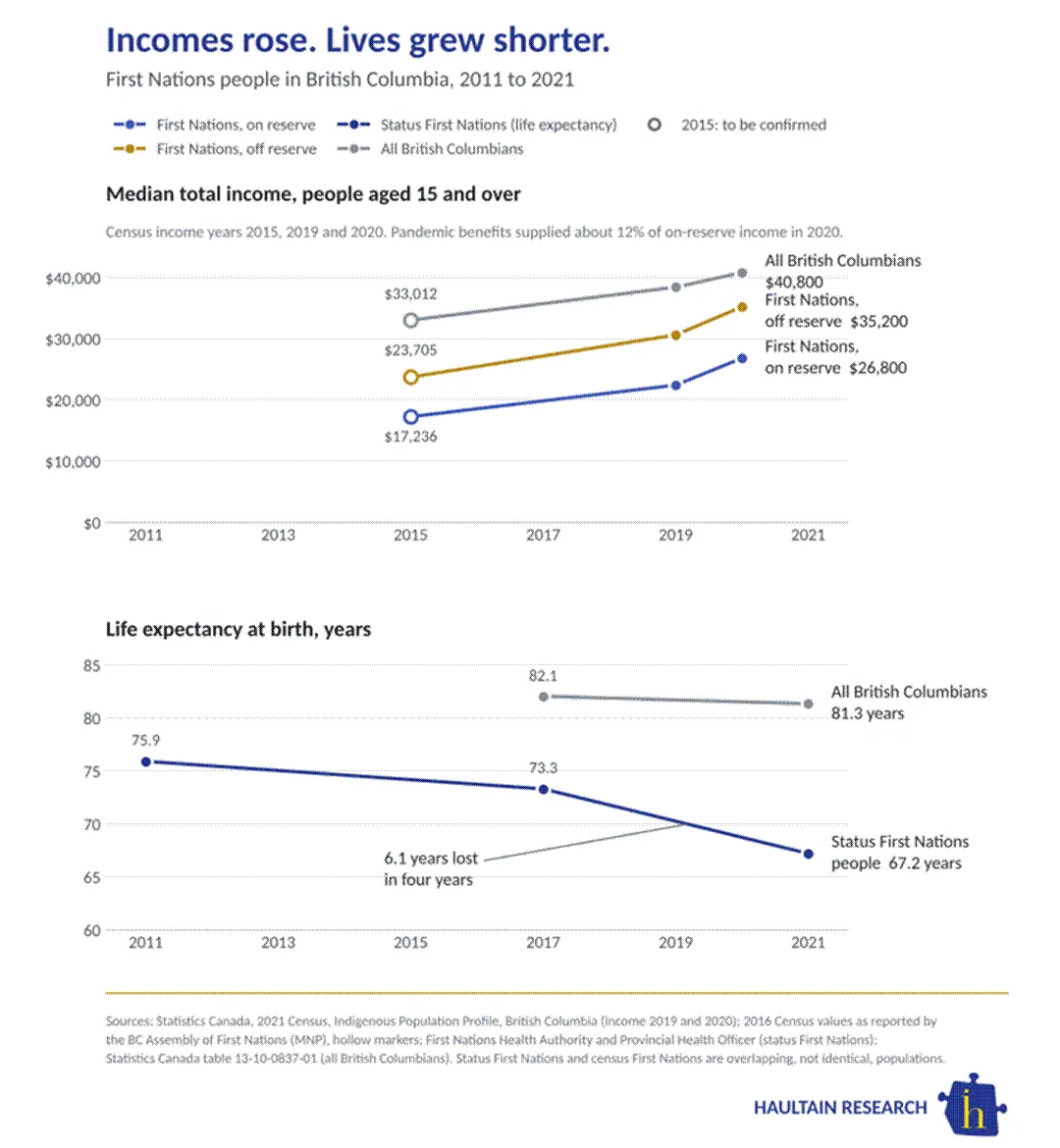
The decline did not begin with these governments. Life expectancy among First Nations people had already slipped from 75.9 years in 2011 to about 73 in 2017. After 2017, the pace of loss more than tripled. The health authority attributes the losses to toxic drugs and COVID-19. Those causes explain how people died. They do not explain why a decade of an incessantly declared priority for Indigenous welfare and swelling budgets failed to protect them.
The health authority adds that First Nations people “continue to be disproportionately [affected] due to the ongoing and intergenerational effects of colonialism.” Those effects are real, and they are old. They explain why First Nations people were more exposed; they cannot explain why a decade devoted by two levels of government to repairing them ended with shorter lives.
Toxic drugs point to a choice both governments made. In March 2020, Victoria endorsed clinical guidance for doctors to prescribe pharmaceutical opioids and stimulants to drug users, and in 2021 it made this “safer supply” provincial policy. Ottawa then exempted British Columbia from the federal ban on toxic drug possession, so that from January 2023 adults could carry up to 2.5 grams of opioids, cocaine, methamphetamine or MDMA without being charged.
Not surprisingly, deaths from toxic drugs among First Nations people peaked that year, just like they did across the province. Victoria let the exemption lapse in January 2026, its health minister conceding that the pilot “has not delivered the results we hoped for.” They could have chosen to stop it sooner, but did not. Coincidence in time proves no cause. Pretending it away would be foolish.
Alberta offers a test. Thanks to progressive myth, Alberta is supposedly a land unfriendly to immigrants and Indigenous peoples. In January 2026, for example, Alberta NDP Leader Naheeed Nenshi declared that “Danielle Smith and her separatist UCP government do not respect Treaty rights.” After Alberta’s treaty chiefs allied with the NDP to pass a vote of nonconfidence in her government in February, Nenshi told the legislature that Eby “didn’t face a vote of nonconfidence by First Nations. Only this Premier did.” Thus, on progressive logic, a government that disregards First Nations should preside over far worse results than British Columbia’s.
Yet the pattern in Alberta is very similar. A 2025 study in a Lancet journal, drawing on Alberta Health records, found that life expectancy among First Nations people in the province fell 7.3 years between 2019 and 2021, from 70.4 to 63.1. Other Albertans lost 1.4 years. The figure recovered slightly, to 64.2, in 2022. Figures from Alberta Health, reported in early 2025, put it at 62.8 years in 2023, against 81.9 for other Albertans. The two provinces identify First Nations people differently, so their life-expectancy levels are not strictly comparable. The direction of change can still be compared.
I could find no life expectancy figure for First Nations people in British Columbia for any year after 2021. Canada’s national death records once noted racial origin, but the practice faded after the 1970s as provinces dropped the question from their forms, and Statistics Canada’s death database now records no Indigenous identity. British Columbia’s figures therefore depend on linking death records to the federal Indian Register, and the health authority’s next update is projected for 2026-27. Its counts of toxic drug deaths offer the closest guide to the years since. Deaths among First Nations people rose from 361 in 2021 to 458 in 2023, then fell to a preliminary 289 in 2025, still 5.4 times the rate of other residents.
(Strictly for reference: In 2021, Bolivian life expectancy was 62.6 years with an income of CDN $2700; Honduras, the second poorest country in this hemisphere, had a life expectancy of 69.5 years and a median income of CDN $4118).
A government accused of hostility and a government that proclaimed to the four winds and wrote its goodwill into law presided over comparable collapses. Whatever drove the decline, the warmth of official progressive declarations and truckloads of money did not stop it. There are deeper issues at play here.
Haultain Research is a reader-supported publication. To receive new posts and support our work, consider becoming a free or paid subscriber. You may also support us by sharing our work with like-minded friends and family, or making a modest donation at www.haultain.org
I have my own theories about why the numbers look the way they do. Those can wait. Anyone who funded, designed, or voted for the past decade's policies should measure the distance between what they intended and the outcomes they produced. Policymakers and voters alike should at the very least suspend the common assumption that lavishly pouring public money into Indigenous communities will, by itself, improve their lives, at least until someone explains why it has not done so.
Where is the money going if it is not improving the lives of real people in Indigenous communities, one has to ask? One need not begrudge the significant increase in allocations to Indigenous people to ask accountability questions, especially when the results show the opposite of what one would expect.
Ottawa’s budget watchdog saw the pattern early. In May 2022, the Parliamentary Budget Officer reported that the rise in federal spending on Indigenous services “did not result in a commensurate increase in the ability of the organizations to achieve the targets that they had set for themselves.” Three years later, Auditor General Karen Hogan found that Indigenous Services Canada had made “unsatisfactory progress” on 53 per cent of 34 recommendations from six audits completed between 2015 and 2022.
On June 5, 2020, Justin Trudeau took a knee at the anti-Black racism protest on Parliament Hill in Ottawa, eleven days after George Floyd’s killing. Floyd was not Canadian and was not Indigenous. There was no reaction from Justin Trudeau after the 2022 Budget Officer’s Report cited above; not eleven days later, not ever. Thousands of Indigenous lives affected by his policies did not merit a knee, did not matter as much.
In Victoria, the auditor general found in 2015 that the education ministry had not evaluated whether its targeted funding for Indigenous students was closing gaps in outcomes, and in 2019 that it still had not. I know of no comparable provincial reckoning of Indigenous health spending against outcomes.
Elected governments and their officials need to get to the bottom of this. Legislators in Victoria and Ottawa should commission an independent inquiry into why First Nations people's lives grew shorter during the most generous decade on record, with full access to health, coroners’, and spending data. Victoria should begin by publishing life expectancy for First Nations people every year; the linked records that make it possible are rebuilt annually. Investigators should take their time, and the rest of us should partially suspend judgment until they fully report.
Between now and the Oct. 24 vote, Premier Eby will make even greater promises to British Columbians, some of them to Indigenous communities. Voters should hold each one against the past decade’s record.
I am not suggesting or implying that all of the above is Eby’s fault, but he sat at the cabinet table, and then at its head, for most of the decade the record describes.
Announcements and good intentions are never enough. The last decade has once again supplied the evidence.
This is a superb article. We need answers to these questions.