


This is a reader-sustained Substack, and we are grateful for the support of our readers. If you like what you read, feel free to obtain a paid subscription or make a donation.
Earlier this week marked the bicentennial of Thomas D’Arcy McGee’s birth. He was a statesman, poet, and Dominion martyr whose name might echo through the chambers of Parliament and the hearts of Canadians if Canadians and their Parliamentarians knew more about who he was. Outside of a few commemorations, his life passed quietly into history’s footnotes.
It should not have.
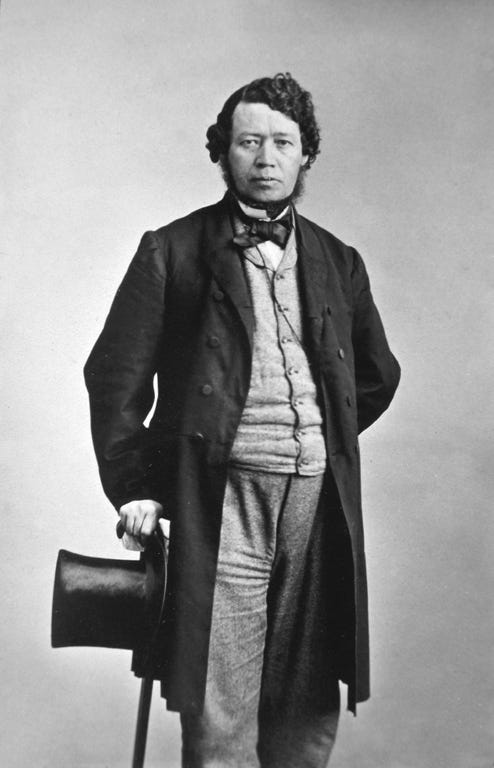
D’Arcy McGee’s life (1825–1868), his courage, political conversion, and murder offer not just a biography but a warning. He lived in a time of rising ethnic tension, economic uncertainty, border insecurity with the United States, surging revolutionary fervour, and a young country struggling to forge a lasting identity. He chose light over darkness. He turned from tribal nationalism to constitutional order, from romantic rebellion to sober statecraft.
And in many ways, we live again in such a time without such leadership.
Canada in 2025 is fractured by geography and by worldview. Fragmented identities, fostered by political factions, jostle for attention. Youthful ambition suffocates under regulatory orthodoxy. A governing elite, improvising as it moralizes, flirts with empty ideological crusades that demand sacrifice from the citizenry while enriching and empowering a narrow few.
D’Arcy McGee’s life reminds us that freedom without virtue is an illusion—and that the greatest threat to a pluralist society is not diversity of views, but the cultivation and importation of multiple divisions disguised as justice.
The Fenians Then, Hamas Now
The Fenians were a 19th-century Irish republican movement committed to overthrowing British rule by force. In Canada, they formed a network of exiles who aimed to draw the colonies into their war. They raided across the U.S. border, smuggled weapons, infiltrated communities, and plotted assassinations—including that of D’Arcy McGee in 1868.
In 1866, McGee warned that such elements were “sworn to achieve Irish independence by means of an armed revolution, and as such, enemies of the Queen’s peace” (Parliamentary Debates, Province of Canada).
Hamas today operates with disturbingly similar logic: a foreign movement with a totalizing, violent, religiously absolutist ideology, now tolerated, and in some cases even sympathized with, inside Canadian institutions and government corridors. Like the Fenians, their imported rage seeks not to coexist within Canadian society but to repurpose it as a staging ground for other people's wars.
Hamas is a listed terrorist organization in Canada. Its stated mission is the destruction of Israel, and for some among them, the establishment of an Islamist Caliphate. Many of its supporters also display open hatred for Canada and contempt for Canada’s constitutional values. That Canadian authorities have largely looked the other way is a measure of how far the Laurentian elite of today has drifted from McGee’s moral clarity.
While not all supporters are violent, the ideological project they defend is anti-democratic, theocratic, and revolutionary, just as the Fenians were ethno-nationalist, militarized, and absolutist. To endorse and welcome Hamas (or any other ethnic or nationalist foreign feud) is to adopt the Fenian principle: destroy the host society to serve a cause rooted in identity, grievance, and blood.
McGee’s Conversion and Philosophy
D’Arcy McGee began as a firebrand. Born in Ireland in 1825, he absorbed the romanticism of rebellion and joined the failed Young Ireland uprising of 1848. He fled to the United States, where he embraced republicanism and Irish nationalism, initially including the Fenians.
But by the time he arrived in Montreal in the 1850s, McGee saw what others did not: that Canada could not survive as a collection of imported murderous feuds. He became a Member of Parliament, broke with the radicals and embraced a vision of peace, pluralism, and spiritual order.
In his famous February 9, 1865 speech, he described Canada as “a new northern nationality... with the institutions and system of government best suited to our own peculiar condition” (Confederation Debates). He saw hope not in revolution, but in the inheritance of British political tradition.
McGee’s philosophy was shaped by experience. He had lived among revolutionaries and seen the ruin they left behind. In Canada, he became a voice for constitutional nationalism, loyal to the Crown, committed to pluralism, and anchored in moral responsibility.
“There is a manifest difference between self-government and no-government at all,” he warned during the Confederation Debates. There is also a difference between self-government and excess government in our lives.
He rejected ethnic and sectarian division. His call was for unity, not uniformity, but a civic unity grounded in shared obligations:
“Let us then be Canadians... not Upper Canadians nor Lower Canadians, but Canadians ‘sans phrase’” (Feb. 9, 1865).
He understood that majorities, no less than minorities, can be wrong: numbers do not equal justice.
Faith, primarily Catholic teaching, informed McGee’s view of order and liberty. Religion, for him, was universal, not tribal. He believed liberty, without moral grounding, would devolve into license as a gateway to chaos. His Catholicism led him not to exclusion but to the universality of shared restraint.
McGee defended minority rights not as handouts, but as protections for civil peace. He understood that pluralism without a binding principle yields anarchy. For McGee, that principle was the Crown, representing continuity, lawful authority, and shared allegiance beyond faction.
He understood, like Tocqueville, that societies and constitutions are “formed out of the habits of the heart,” not solely through positivist law and rational design. A nation cannot live by policy alone; it needs memory, virtue, and conviction.
A century and a half later, the Laurentian leadership lacks all three.
A Country Divided, A Legacy Betrayed
When McGee was assassinated in 1868, Western Canada was still a frontier. He did not live to see Alberta and Saskatchewan join Confederation, nor to witness the extraction of the West’s wealth in the name of other people’s ideologies.
But we can say confidently: he would not have sanctioned one region's economic or political exploitation for the ideological indulgence of another.
His model was built on balance and reciprocity, not imposed sacrifice. He rejected the revolutionary logic of justice-as-reversal, where one group is punished so another can be elevated. That same logic now powers Ottawa’s radical environmentalism, which demands the shutdown of Western industries in service of a planetary creed.
He would have called it what it is: false piety masquerading as public good.
Meanwhile, Laurentian Canada (Toronto, Ottawa, Montreal, and Quebec City) remains entrenched in its ideological comfort. Its elites, insulated by inheritance and inertia, have become stewards not of a country, but of a largely failed narrative.
Where McGee sought to harmonize, they divide. Where he built on faith and prudence, they govern by abstraction, symbolism, and fear.
McGee would feel most at home in the Prairie West among people still rooted in human reality, bound by land, and animated by common sense. Just as economic power has shifted West, so too has the moral centre of Canada’s promise.
Conclusion: Restraint in an Age of Revolution
D’Arcy McGee believed in constitutional accountability: of citizens to their country, and of governments to their people. He knew a nation cannot survive when its leaders are more loyal to ideology than to truth, or to power itself. He understood that, untethered from virtue, revolutionary dreams become the blunt instruments of tyranny.
And that’s precisely what the global green crusaders and Hamas apologists threaten to impose today: the repackaging of coercion as compassion, and ideology as progress.
In a secular age in which most do not understand the religious experience and obey the cliché that religious beliefs lead to war and killing, it is worth pointing out again that D’Arcy McGee’s Catholicism did not narrow him; it expanded and fortified his moral range. It led him to a higher form of civic inclusivity, based not on grievance but on shared commitment and institutional restraint.
His legacy is not nostalgia. It is nearly necessity.
Canada’s current elites, obsessed with purity and performance, have lost sight of the “new nationality” McGee envisioned. The question is no longer whether Canada is salvageable. It might not be. It is whether today’s leaders even understand what D’Arcy McGee sought to build, and what they’re in the process of dismantling.
In their rhetorical battles with the United States, Laurentian elites claim to defend Canada, but they no longer understand it, if they ever did. They reject the West’s aspirations not because they conflict with Canada’s ideals, but because they are those ideals.
McGee warned that foreign ideologies, left unchecked, would lead to bloodshed. For that warning, he was murdered. He is Canada’s first (but not only) civic martyr.
We owe him more than remembrance. We owe him honesty. D’Arcy McGee did not die for our elites to trade away loyalty for ideology, unity for tribalism, or truth for the expediency of politics.
Remembering D’Arcy McGee is not to mourn a long-gone past but to recover the vision of the future he died for. In an age addicted to post-historical amnesia and revolutionary progress, the most radical act might be restraint.
This is a truly impactful reflection on the struggles endured to build our beautiful and once, once peaceful country, akin to the anguish of living through what should have been its completely preventable demise.
“His legacy is not nostalgia. It is nearly necessity.” Thank you for this insightful article. McGee would make a wonderful central character in a future film, something we are considering for our work at Strathcona Studios.