


In a few weeks, Albertans will be voting in municipal elections — so I thought it was timely to share this post from September 2024. The numbers and amounts at the end will have changed, but the issues and principles discussed remain the same. Governments should stick to their core competencies and leave the rest to the market (September 2025).
The more we accept government intrusion into our lives, however minor it may seem, the more politicians and bureaucrats are encouraged to keep doing it. Left unimpeded, they will find more and deeper ways to intrude into our daily decisions and activities, even in Alberta.
Recycling as a Private Business
Sometime in the year 2000, after moving to Okotoks (Alberta), I signed up for a service to pick up our recyclables. A young man in the next town had started a recycling pickup service, bought a square van, refitted it, and went into business. I seem to recall paying $12 monthly for the service.
No one forced us or compelled us to do it. We did it because we wanted to; it saved us time. We also wanted to help the young entrepreneur. He came by once a week to pick up the bin.
A few years later, his business grew, and he had a second truck working. He was prospering. But he was forced to shut down soon after acquiring a second vehicle —and the debt that came along with it. Despite his upward growth trajectory, the politicians in the Town of Okotoks decided to disrupt his business. They gave themselves the authority to operate a recycling program, charging half the amount to everyone, whether or not they wanted it. With the stroke of a pen, they seized most of the market share by making it compulsory for residents to pay for a recycling service.
We didn't have the option to retain the service we had. The town recycling charge was compulsory, and even if we had decided not to use the mandated service, we would have had to pay for it and the one we had chosen to use. I was also the sole earner with the salary of a part-time faculty member, feeding my family, so I could not afford to pay for both.
I am not sure how it all unfolded for the young entrepreneur, but I am sure that the town disrupted his business model, and he had to close it. He could not compete. By fiat, the politicians muscled him out of the business he had created from scratch to provide for his young family. The Town operated no differently than rackets or the mafia do, minus the violence — though some could argue that forcing you to shut down your business constitutes violence to your business. Strictly speaking, it is not violent, but no less devious, intimidating and coercive.
The Mandatory Service
Fast forward over two decades. Last year, on a weekday in the spring, someone rang our doorbell in South Calgary. Someone from City Hall, wearing a colourful badge, stood there and told me he was there to teach us about recycling. Jyoti Gondek sent him. He attempted to hand me a large brochure, which I made no effort to receive, but asked what it was. He said it was instructions on what and how to recycle correctly. City Hall was displeased that people in our area were putting things in the recycling bin that the bureaucrats didn’t want.
So here we were, in 2023, being educated. The mayor of Calgary had decided that we and the rest of our neighbours needed a city-imparted crash course to educate us on what to put into the city's mandated recycling bin, and this was right at our doors. What a thoughtful mayor! How convenient for us!
I thanked the young man but declined his instructional offer. He wanted to know if I had any questions, so I asked how much the city spent on recycling and how much the instruction effort would cost. Not surprisingly, he had no response. "I meant about recycling," he said, "questions about recycling," completely unaware that he was being asked questions about recycling.
He seemed to get the thrust of what I was asking, nonetheless, because he quickly switched gears and told me the reeducation campaign would save us money. Every time an obtuse citizen puts the wrong kind of paper or plastic in the bin, it increases the cost of recycling. So, the better trained/indoctrinated the public, the less expensive recycling would be. City Hall was trying to be fiscally responsible, he hinted, saving us money by reducing the recycling cost.
I ignore, of course, what and if the city had tried other things to increase their efficiency in recycling. I assume they may have tried different things. At that moment, however, I did know that someone had decided that it would be okay to push and impose, showing up at people's doors with an accusative finger to reeducate us, the citizens who pay for the service. Why was that okay? Would it be alright if nurses showed up at our doors to tell us how best to eat and exercise, on the excuse that it would save us money for the healthcare system?
I asked the young man to convey to the mayor that I did not appreciate having agents of the state sent to my door, nor spending money on re-educating the citizenry to make her job more manageable. The young entrepreneur in Okotoks never showed up at our door to reeducate us on how to recycle so that he could save money in sorting costs, nor did he send a condescending envoy to do it. I am also sure that if I had placed the wrong plastic colour in the bin, he would have dealt with it. However, the public provider, free from market pressures and emboldened by the monopoly, does not. The consumer must be inconvenienced for the convenience of the technocrat and the politician.
I will admit that I lack the imagination to see how, short of ingesting it, a "non-stretchy" plastic bag might injure someone handling it. I understand there is an obsession with safety, and where the obsession dwells comfortably, it knows no bounds. There is no cost that technocrats are not willing to impose on others for safety when those they aim to protect pay the bill. COVID-19 proved in spades that masking what bureaucrats and experts crave is to control what people do and do not do, simply because bureaucrats can (but they can only do so if we allow it).
It is not that I am callous and do not care about people's safety or the risks of being injured. But I do know every activity involves risk, and one cannot purge all risk from the horizon, no matter how much one tries. Often enough, thoughtless attempts at reducing risk bring even greater risk. There is always a cost to taking risks, and there is also a cost not taking risks.
Who is Obligated to Provide Solutions?
The point here is that the responsibility for safety and keeping costs down suddenly shifts to those who are already compelled to pay for the service. The user is being blamed. Why should the user have to correct course instead of the service providers finding solutions?
Who is providing a service to whom? Who is paying whom? Why is it beyond city hall’s capacity to deal with non-stretchy plastic if they are forcing us to recycle? I am not talking about people putting potentially explosive gas canisters in the plastic recycling bin. The recycling retraining is similar to when Calgary City Hall blamed the public for the spread of COVID-19. Government overreach in recycling can stifle innovation and market competition. [2025 comment: This is the same logic used when New Brunswick’s premier forced people to stay away from wooded areas]. The lack of competition stifles the bureaucratic capacity to solve problems.
One could call City Hall and complain about it. Still, their response would be some technical, pre-digested statement about saving money. The response would be designed to protect the assumption that it is best and more economical for City Hall to run the city’s recycling. That attitude is akin to the Costco advertising gimmick on their booklets. Costco always tells you that you could save lots of money. The booklet’s cover might say you could save $1500, which is likely true. It does not say that you could only save $1500 if you bought every item in the booklet, which would cost you $10,000 or more.
City Hall's recycling deal is similar in many respects. If you follow and obey every rule, City Hall would save lots of money. But save to what end? City Hall would always find a way to repurpose that money for equity and inclusion, rainbow sidewalks, pride parades, electric buses and firetrucks, climate emergencies, and travel to Paris for climate conferences. If saving our money is the goal, let’s retire the compulsory recycling plan, shall we?
The City of Calgary has a projected 2023-24 surplus of $147 million. They have not abandoned their desire to spend over $80 billion in their fantasy of an "emergency" to address a contrived planetary crisis. They'll spend your money on the pretense of fixing the planet, but cannot maintain critical infrastructure such as water mains. As I write, all Calgarians are being compelled to reduce their water consumption and shower less or for less long, for example, to compensate for their gargantuan ineptitude. But they claim they can save the planet with the same money out of your pockets.
Their pursuit of savings does not improve the service or necessarily benefit the taxpayer.
The Coercive Service
Bureaucrats know that stupid rules without fangs are useless. What good would it do for apparatchiks to threaten people for not following dumb rules if there were no means to force obedience to their rules?
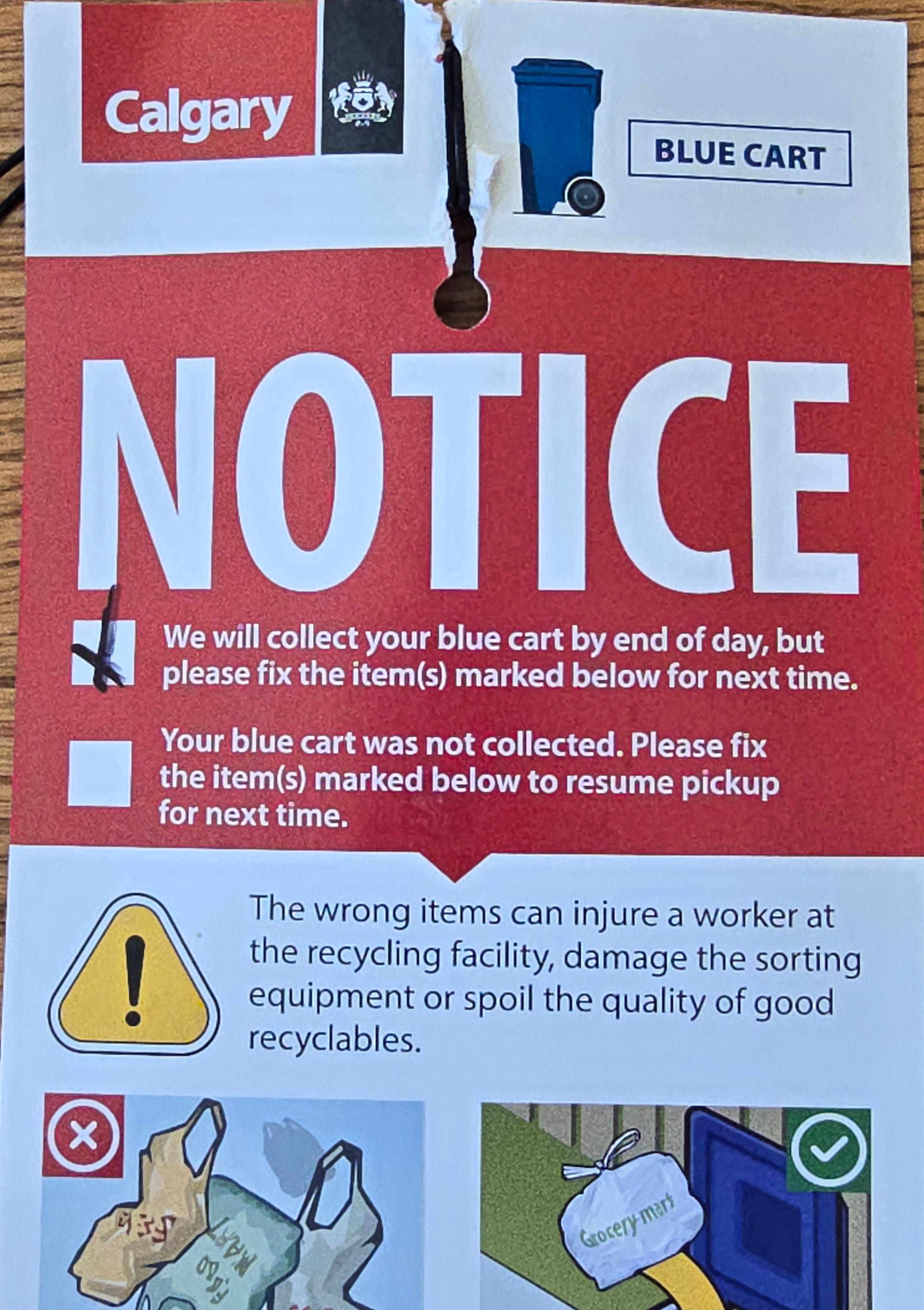
A few weeks ago, I went to bring our recycling bin inside and noticed a tag hanging from the side. The long tag printed in cardstock had 12 colour illustrations of recycling transgressions, six on each side, with the corresponding image of a "correct" way to do what they want you to do. The tag had a stern command disguised as a request. "We will collect your blue bin by the end of the day [this time], but please fix the item(s) marked below for next time [or we will leave it here uncollected]." The nasty part of the threat was left implied.
Someone had been through our bin and "inspected" its contents, looking for violations of the correct way to recycle. Right next to a yellow triangle with an exclamation mark that Jerry Seinfeld would be proud of, it read: "The wrong items can injure a worker at a recycling facility, damage the sorting equipment or spoil the quality of good recyclables." I’ve read that Calgary's recycling contamination rate is approximately 20%, which increases costs. Our violation involved, you probably guessed it by now, the presence of "non-stretchy bags and wrappers."
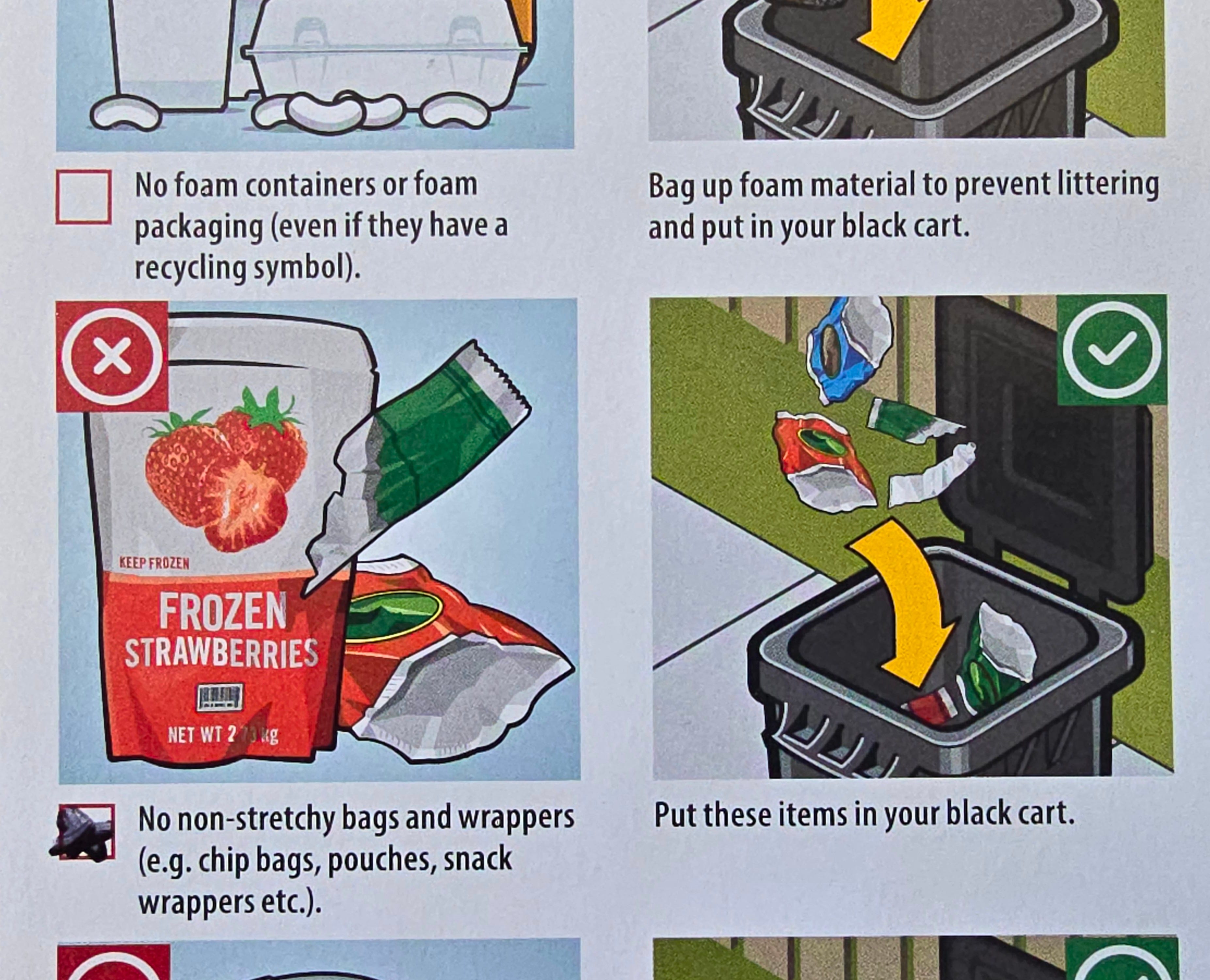
I am sure the young entrepreneur in Okotoks would have called it to our attention if we had put empty butane canisters in the recycling bin. I get that there are limits. My question is whether there are limits to the desire of the "experts" to blame the average non-expert residents, and whether there are limits in their minds as to where to draw the line in pushing the public to do rather than provide the solutions to their problems in the exercise of their responsibilities in their jobs.
In keeping with the coercive pattern, the inspectors returned to follow up on the recent warnings and infractions in the neighbourhood last week. I observed the pair of them, one on each side of the street, going from bin to bin, rummaging through the contents, clipboard and pen in one hand, ready to note every infraction and match the notes from the previous visit to determine whether there were repeat or new offences.

I went outside and waited at a safe distance from our bin on the street. I did not want to get too close and risk an incident. I greeted the young "inspector" with a friendly hello, which she reciprocated. I lifted my phone camera and started filming as she approached our bin. I wanted to capture the inspection of our bin. But upon realizing that she was being filmed, she barely lifted the bin's lid, and without even breaking stride or stopping, let it fall back down and said: "It is all good here." (Out of respect for the young lady's privacy, I will not be posting the footage here). She kept right on walking, and I went back inside the house.
I do not recommend the tactic, however. Leviathan and its agents do not always feel intimidated by a camera.
The Economics of It
City Hall could save lots of money by spending more responsibly and letting market forces provide solutions to problems more efficiently and affordably. Principally, City Hall could save truckloads of money by staying in its lane. The mayor of Calgary should refrain from spending money on language causes in Quebec. Human Rights in another province is not the business of the Mayor of Calgary. Neither is saving the planet. She is not even a member of the Justice League, despite her fondness for dressing up in costumes and pretending to be one. City Hall has no jurisdiction in healthcare either. The city should not be inventing health mandates without the province's authority.
City Hall may have believed it could save residents money by grabbing the residential recycling business and forcing everyone to recycle through its gracious services. But that does not seem to be the case.
Assessing the amount of money invested in capital spending for recycling over the years is challenging. Still, it is in the tens of millions, which makes it even more difficult for the City to walk away from the activity now. Similarly, once grants for gasoline, equipment, maintenance, salaries, benefits and many other expenses are tallied, the operational cost of running the recycling in detail is unknown.
Calgary's municipal recycling program budget is approximately $37 million annually, and we know from City Hall figures that the green and blue recycling program accounts for over 70 percent of the total waste/recycling funds that the City receives from direct resident fees. Government-run recycling programs can have administrative overheads of up to 20%. For the 2025 year, Calgary projects charging $26.40 per month for waste and recycling bins, of which $19.01 is for green and blue recycling bins. That means that the direct cost of recycling is 72 percent. I would happily pay $25 monthly for recycling if it meant having generations of City Hall bureaucrats and politicians off my back.
City Hall needs to stick to its core competencies and let the market do the rest. They need to get out of the recycling business, which private enterprises can do—and do much better. Private recycling companies often achieve higher recycling rates, up to 75%. Calgary plans to spend $173.53M in waste management and recycling in 2025, up from $158.144M in 2023. It is worth noting that proposed infrastructure and engineering (outside of streets and sidewalks) spending for 2025 was only $6.176 M, legal costs were $13.418M, and climate and environmental management were $24.437M. No wonder the water infrastructure is falling apart.