


This essay is a personal reflection to try to make sense of how self-identified queer people can support Hamas killers who would not hesitate to murder them. It is not the usual material I share here, but I thought some readers might appreciate this line of inquiry if they, too, have been puzzled by what appears, at first sight, to be an absurd contradiction. If this isn't your cup of tea, don’t sweat it: ignore it.
I wrote this reflection a few days before Charlie Kirk was murdered. If it is true that his assassin had a trans lover, the link between murderous terrorists and trans culture just got a bit tighter, and the relevance of the connecting ideas just got more interesting. To make sense of that, I also wrote the Post Script below.
A year ago, Zakarya Rida Hussein was sentenced to six years in prison on terrorism-related charges, including plans to bomb Calgary’s Pride Parade in 2023. I will confess that since then, I have been trying to understand somewhere in the back of my mind how, in light of these things, there can be people such as Queers for Palestine. Remember that the Hamas killers attacked a music festival bubbling with young people, some of whom were very liberal, pacifists, sympathetic to queer culture, and there may have been a few homosexuals among them.
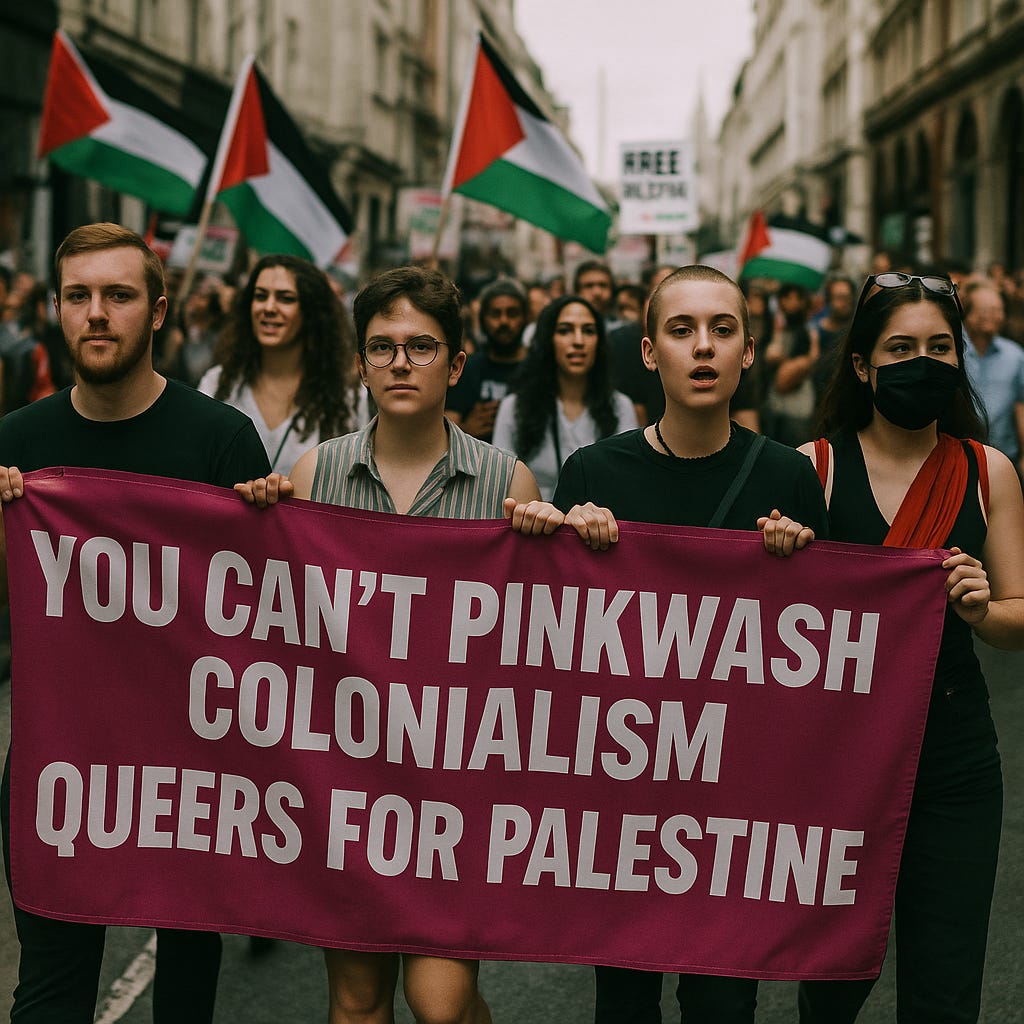
Most people encountering the slogan “Queers for Palestine” are genuinely puzzled. At first glance, it seems a contradiction. How could sexual minorities, who are despised and often violently repressed in Palestinian society, align themselves with movements like Hamas? How could those who march under the banner of sexual liberation stand in solidarity with people who would imprison, beat, or execute them for who they are?
If this is not a contradiction, it is at the very least a paradox. A paradox, according to the Oxford English Dictionary, is “a statement or proposition which, despite sound (or apparently sound) reasoning from acceptable premises, leads to a conclusion that seems senseless.”
To begin making sense of this paradox, one must first understand the cultural ethos of queer and trans politics in the West. At its core lies an affirmation of the self over the world. Queer identity is not framed as a discovery of one’s natural place within a larger order but as an assertion of will against social and natural constraint. A male body may declare itself female, and the declaration is truth; biology, tradition, and reality are compelled to give way before the sovereign act of self-identification.
The ethos is not simply one of sexual freedom, but of metaphysical primacy: the idea is truer than the physical body, the person’s will stronger than nature. In this way, queer culture insists that the authentic self is whatever it declares itself to be, and to question or deny that declaration is disagreement and an act of violence against s/he that declares it.
This self-sovereignty often takes the form of treating one’s former self as dead. That is why trans activists oppose “dead-naming:” to utter their old name is to resurrect a ghost that must remain buried. Yet this death is only symbolic, not actual; it exists in the realm of idea rather than fact. Still, it reveals a deeper morbidity. Many who transition describe themselves as having felt “dead inside” before. Through surgical transformations, they embrace sterility, cutting off the possibility of reproduction — a generational death that mirrors the symbolic one. In this way, queer affirmation becomes Kirilovian: freedom dramatized not through flourishing but through the destruction of natural continuity, proving the self by negating the past and sacrificing the future.
Islam in its traditional form represents the exact opposite. If queerness is the exaltation of will, Islam is the submission of will. The word Islam means submission to God and to divine command, patriarchal order, and the disciplines of family and tradition. Sexual permissiveness is condemned as sin, patriarchal authority is upheld, and in its most radical forms, homosexuality is not tolerated but punished by death.
In Gaza, queerness is not celebrated but hunted and punished. For Islamic law and custom, queer identity is indulgent chaos, rebellion against the divine order, and a threat to family and traditional authority. For queer activists, Islam represents patriarchy, misogyny, sexual repression, rejection, and violence. By any straightforward reckoning, these two worldviews are different and directly antagonistic. Yet it is precisely here that we find the strange phenomenon of Western queer activists marching in solidarity with those who despise them and wish to eradicate them. How does it work?
This inversion only begins to make sense once one recalls the Marxist inheritance that shapes much of contemporary activist thought (Decolonization, supposedly undoing colonialism, is a Marxist variant). Marxists are materialists and harbour no belief in eternity. History is all there is. Marx divided people into oppressors and the oppressed, the bourgeoisie and the proletariat. The proletariat was not merely the suffering working class but the bearer of historical virtue, destined to redeem humanity through violent revolution. Oppression, in this framework, is not simply misfortune; it is the source of moral authority. To be oppressed is to be pure; to be powerful is to be guilty.
That logic survives in today’s politics of identity (See your typical socialist, welfare recipient among us in Canada). The terms have shifted — colonizer and colonized, white and non-white, West and non-West — but the structure of their thinking remains. The victim is virtuous; the powerful are corrupt. In this symbolic economy of “values,” Palestinians are the sacred victims of (our) time (history), the colonized and dispossessed. Israel, and by extension the West, represents the oppressor.
To side with violent Palestinians is to side with history’s virtue (their equivalent of the eternal); to side with Israel is to side with history’s guilt (Hades). Marx also insisted that liberation is not achieved through compromise but through violence. Revolution is the necessary weapon of the oppressed, the midwife of history bearing the New Man. By this logic, when Hamas fighters massacre innocent civilians, their violence is reframed as a legitimate and even noble act of historical necessity, the oppressed striking back against their oppressors, no matter how malignant, gruesome or vile. In the Marxist symbolic order, Kalashnikovs and bombs are not crimes but instruments of emancipation. This is why queer radicals can proudly affirm “solidarity” with killers. The very violence that would destroy them is reinterpreted as liberating, as if bloodshed itself, like in Voodoo rituals, carried cleansing or redemptive meaning.
For queer activists, aligning with Palestine reinforces their own self-image as victims. As sexual minorities, they already see themselves marginalized; by joining their cause with the supposedly colonized, they augment their historical virtue. Victimhood becomes the badge of their purity.
The result is that the brute fact of Palestinian spiritual and physical hostility to queerness is set aside. Survival itself becomes secondary to ideology because the physical is subordinated to will. Solidarity with the oppressed matters more than what the oppressed might actually do to them. What matters is to stand on the right side of the historical victimhood narrative – their version of the eternal.
At this point, the paradox is already troubling, but it goes deeper still. What underlies it is not only Marxist categories of oppression, but something darker: a form of nihilistic affirmation that Dostoevsky described in the character of Kirilov in his novel The Possessed (also translated as The Devils). Kirilov is a man who traffics in certainties and is therefore not concerned with G-d, or Providence. If there is no G-d, then man is absolutely sovereign, and to demonstrate his absolute sovereignty, Kirilov freely chooses to end his own life. He believed that ultimate freedom could be proven only by suicide. For Kirilov, suicide was not self-denial but self-affirmation, pure will, the absurd demonstration that man possesses the ultimate freedom to destroy himself.
A similar logic of nihilistic affirmation echoes in contemporary politics. The suicide bomber affirms his cause by annihilating himself and others. Gender radicals, feminists among them, affirm with the same certainty that “trans women are women,” even as the affirmation erases the very category of womanhood they once saw as form of victimhood. And so, gender activists and queer radicals affirm solidarity with a violent movement that would kill them without remorse. In each case, the self is not negated but sovereignly affirmed to the point of absurdity, proved in the very idea of destruction.
Here lies the core of the paradox. Its adherents do not see “Queers for Palestine” as a contradiction. It is, to them, a proof of authenticity. By standing with those who despise them and would murder them, they demonstrate that their identity is not about comfort or safety but about the purity of victimhood and their political will. To affirm the self so radically that one can embrace solidarity with the executioner is to display a kind of ultimate freedom. It is Kirilov’s suicide transposed into an idea of activism: a self so sovereign that it can willingly risk its own annihilation for the sake of proving its ideological purity. The difference is that Kirilov did not deal in risk.
The queer and trans advocates are performative present-day Kirilovs; except that they are unwilling to die. The spectacle is not ultimate liberation but pathology. It reveals how the cult of victimhood, nourished by Marxist categories and sustained by resentment against the West, leads not to freedom but to a death-drive of words, not quite to the death of the proponent. The ordinary observer expects solidarity to be built on shared values and mutual recognition. In this world, solidarity is built against those things as an act of ideological theatre. The proponents believe they are affirming their truest selves, yet they are affirming the idea of their own disappearance. Their politics is not a politics of life but of purity — and purity, carried to the extreme, demands a sacrifice in the idea.
The slogan “Queers for Palestine” is therefore more than a curiosity. It is a symptom of a moral bankruptcy and cultural crisis in which ideas take primacy, masquerading as will. Survival is placed second to ideology, and self-affirmation is proved through self-erasure. It is the nihilism Dostoyevsky foresaw, but in watered-down form: the freedom that proves itself by a suicidal idea. And it is the tragedy of a culture that, in prizing ideological righteousness above the physical world and existence itself, can no longer tell the difference between liberation and annihilation.
A Note on Critical Race Theory
Critical Race Theory (CRT), though originating in American legal scholarship, now shapes much of the broader discourse on identity and oppression. Its central claim is that race and related identities are not only matters of personal prejudice but are embedded in the very structures of law, culture, and social practice. Equality before the law is treated not as neutral but as concealing systemic advantages; narratives of “color-blindness” or “meritocracy” are unmasked as reproductions of hierarchy. In practice, CRT extends the binary of oppressor and oppressed into the domain of race, identity, and culture. It encourages resistance not merely to individual injustice but to whole systems, and thereby lends itself to the logic of rupture and revolutionary purity. Ruth Marshall’s (See below) research into colonial legacies, nationalism, and belonging is deeply indebted to this frame, which helps explain how her rhetoric can slide so readily into the language of struggle and symbolic violence.
Post Scriptum
Recent events underscore the dynamic I have tried to trace here. On September 10, 2025, American conservative commentator Charlie Kirk, founder of Turning Point USA, was shot and killed while speaking at Utah Valley University. He was thirty-one. After a thirty-three-hour manhunt, police arrested Tyler Robinson, a twenty-two-year-old who, according to reports, lived with a transgender partner. The murder was brutal and symbolic, clothed in ideological signs that sought to give it meaning. It was more than an attack on a man; it was a performance, a declaration that the oppressor’s blood is the final proof of purity.
Authorities revealed that Robinson’s bullet casings bore engraved inscriptions: “Notices, bulges, OwO what’s this?”, “Hey fascist! Catch! ↑→↓↓↓”, “Oh bella ciao bella ciao bella ciao ciao ciao”, and “If you read this, you are gay LMAO.” These markings were deliberate. Bella Ciao is a 20th-century anti-fascist anthem, celebrated as a song of resistance; the directional arrows mimic a video-game weapons code; the “OwO” and “LMAO” invoke meme culture; the gay mockery fuses identity with derision. The killing was framed as murder and as communication. It presented itself as resistance, rebellion, performance — a gesture of ideological theatre. And it was planned. With its staging and symbolic signs, it was a calculated act of ideological violence. The cowardly killing of Kirk shows that the connection between queer sympathy and affinity for terrorist killers crossed from the realm of ideas into deeds.
Charlie Kirk, above all else, was a Christian. He was never shy in saying so, and he far more often invoked Christ’s teaching on love, forgiveness, and compassion than Old Testament codes. The charges hurled against him — that he preached execution of queer people — are outright inversions of what he stood for.
The same destructive logic appears in the case of Robin Westman, who on August 27, 2025, attacked Annunciation Catholic Church in Minneapolis during a children’s back-to-school Mass. Armed with what police described as an arsenal, he unleashed a shooting spree that left two children dead and many more wounded before taking his own life. Westman, a transgender former student of the parish school, chose deliberately: Mass, with its innocence and ritual, became stage and target. The killing of children underscored the extremity of the act, a refusal of the Church’s teaching and of life itself. What for the faithful is the presence of G-d, for Westman was the presence of oppression. His massacre was vengeance, punishment against an institution that would not affirm him.
A related case is Audrey (Aiden) Hale, who in March 2023 attacked the Covenant School in Nashville, killing three children and three adults. Hale, who identified as transgender, chose a former Christian school of personal significance as the target. Police later emphasized that Hale’s motives included notoriety and grievance rather than explicit religious hatred, but the symbolic overlap is striking. Like Westman, Hale turned to a faith-based setting tied to rejection of self-constructed identity. Even when the ideological content is less explicit, the pattern is the same: grievance, symbolism, and slaughter fuse in the pursuit of self-justification.
The history of queer politics shows that affirmation of self has often taken physical form. At Stonewall in 1969, queer patrons of the bar fought back against police with bricks and bottles after yet another raid. This uprising, which sparked the modern gay rights movement, was celebrated as open defiance rather than hidden shame. In the 1980s and 90s, militant groups such as ACT UP staged confrontations with public institutions during the AIDS crisis, chaining themselves to offices, disrupting Mass, and storming government buildings. Their tactics fused performance with aggression. Violence and spectacle became tools of survival, embodied refusals to accept erasure in the face of disease, stigma, and official neglect. The performance was directed against institutions they believed were complicit in death.
Yet the same ethos of militant assertion can slide into darker territory when the framework of victimhood shifts. In the case of Robinson, the murder of Kirk appears as an act of rage and as the extension of this militancy into bloodshed. His life with a transgender partner shaped the symbolic universe in which Kirk could be imagined as a fascist oppressor whose elimination was in his mind righteous. Here, the logic moves from theatrical declaration (“trans women are women”) to militant defense (“protect the vulnerable”) to the shedding of the oppressor’s blood as the ultimate act of solidarity. Violence, once a tool of survival, mutates into a ritual of ideological purity.
This trajectory sharpens the Dostoevskian paradox. In The Possessed, Kirilov affirms sovereignty by killing himself; in Crime and Punishment, former student Raskolnikov affirms it by killing another. Raskolnikov’s act was carefully planned: a murder designed as an experiment to prove whether history belongs to the strong, whether he might live as an Übermensch beyond conventional morality. Both characters seek transcendence through destruction, whether of self or of the other.
Some of these killers replay Dostoevsky’s paradox in the form of self-destruction. Robinson considered ending his own life rather than face capture; Westman turned his gun on himself at the altar. Both echo Kirilov’s logic, seeking transcendence in self-annihilation. Hale, by contrast, followed Raskolnikov’s path, killing others to prove a point, but making no move to end his own life. Together, these cases show how the same ideological scaffolding can bend either way: toward the erasure of the self, or the annihilation of the other, each a distorted affirmation of freedom.
Something similar appears in the case of Ruth A. Marshall, a University of Toronto Religion and Political Science professor suspended after tweeting that “shooting is honestly too good for so many of you fascist cunts.” Marshall may not be a violent person, but her scholarship in postcolonial theory and political theology is steeped in the logic of struggle, and her online handle — a spin on Lenin’s What Is To Be Done? (“Dr Ruth Marshall is Kicking Against the Pricks” → @wtfis2bdone) — signals her revolutionary sympathies. From within such a framework, violent rupture appears less as an aberration than as the natural grammar of resistance. She may not pull a trigger, but she lends moral scaffolding to the gesture.
The same dynamic surfaces in the remarks of Barbara Perry, a sociologist often introduced by CBC as a “hate expert.” In 2018, she founded the Centre on Hate, Bias and Extremism (CHBE) at Ontario Tech University to "advance awareness, understanding and prevention of hate, bias and extremism." In the aftermath of Kirk’s murder, Perry claimed that Kirk had said queer people were “defective and dangerous” and “should be executed.” CBC defended her, suggesting she was commenting on his references to Leviticus and the “LGBTQ agenda.” Yet this framing is profoundly misleading. Kirk far more often invoked Christ’s ethic of love, forgiveness, and compassion than Old-Testament codes. To wrench an isolated citation of Leviticus into his “essential message” is a canard.
Rhetoric like Perry’s works in two ways. To a killer already primed by ideology, it offers provocation: if Kirk is imagined as one who seeks the death of queer people, then striking him down feels like pre-emptive self-defence. Once the act is complete, it offers justification: the slain man is recast as executioner, struck down by poetic justice. The rhetoric of defending life collapses into the tacit endorsement of taking it.
Another echo of this pattern can be found in Nahanni Fontaine, Manitoba’s Minister of Families, Accessibility, and Gender Equity. Shortly after Kirk’s murder, Fontaine reposted on Instagram that Kirk was “a racist, xenophobic, transphobic, islamophobic, sexist, white nationalist mouthpiece” and added, “I extend absolutely no empathy for people like that.” Only later, under political pressure, did she issue an apology. Fontaine is an Indigenous politician whose biography emphasizes her grounding in social justice and identity-based advocacy. Her comments are not incidental: they reveal how the ideological habits of race-theory politics — the sorting of the world into victims and oppressors — can make even the violent death of a political opponent seem less a tragedy than a kind of cosmic bookkeeping.
Here, the paradox I described comes into sharp relief. The self-image of defending the oppressed becomes the license to affirm the executioner. Perry’s claim, Marshall’s rhetoric, Fontaine’s callousness, and the cases of Robinson, Westman, and Hale each show how queer identity and its adjacent culture, when merged with Marxist and postcolonial logics of victimhood, can be drawn toward radical acts of destruction.
The argument I advance here is not that LGBTQ, queer, or trans people are necessarily violent, nor that violence is the inevitable outcome of their identity. The point is that the ideology surrounding queer radicalism, especially when merged with Marxist and postcolonial logics of victimhood, can serve as a ramp for murderous violence. The affirmation of self in rejection of nature isn’t all peaches and cream.
It offers the categories, the moral justification, and the symbolic vocabulary that can transform grievance into murderous vengeance. For most, this remains performance; but for some, like Robinson at Utah Valley University, Westman at a children’s Mass in Minneapolis, or Hale at the Covenant School in Nashville, the same ideological scaffolding became the frame in which murder could be staged as liberation.
None of them proves the thesis alone, but together they add weight to the analysis: that the solidarity of queer activists with Hamas is not a contradiction of values, but part of a broader cultural pattern in which identity, purity, and victimhood converge to sanctify violence. Just as Robinson struck at a domestic “oppressor,” Westman at the altar of the Church, and Hale at a Christian school, so too queer activists affirm the killing nature of Hamas, who would do the same to them. It is Kirilov’s logic once again, blended with Raskolnikov’s; freedom and purity established not by life experience but by the gesture of annihilation, played out in rhetoric, “scholarship,” politics, and blood.
If you’ve found this reflection thought-provoking, consider sharing it or subscribing.