


When I moved to Nova Scotia in 2013, driving across the New Brunswick-Nova Scotia border, I noticed a sign saying it is prohibited to import bees into NS. I chuckled but wasn't surprised; the region likes banning things to push different agendas. Some ban songs, fracking, outside labour, pipelines, for example. Odd but consistent, I thought. I knew nothing about bees, and I ignorantly assumed it was to keep NB competition out. I have since learned differently. The real story is less absurd.
Nova Scotia was not protecting its beekeepers from competition. It was protecting them from a beetle. The province’s hives were free of the small hive beetle, a pest that eats through comb and brood and cannot be driven out once it establishes; the only reliable defence is a closed border. New Brunswick made the opposite bet, admitted Ontario hives for blueberry pollination, and in 2017 found the beetle on the Acadian Peninsula. Nova Scotia had been right, and I had been wrong for a decade. Which raised a question I had never thought to ask: if bees are worth a border, what else about them had I never bothered to learn?
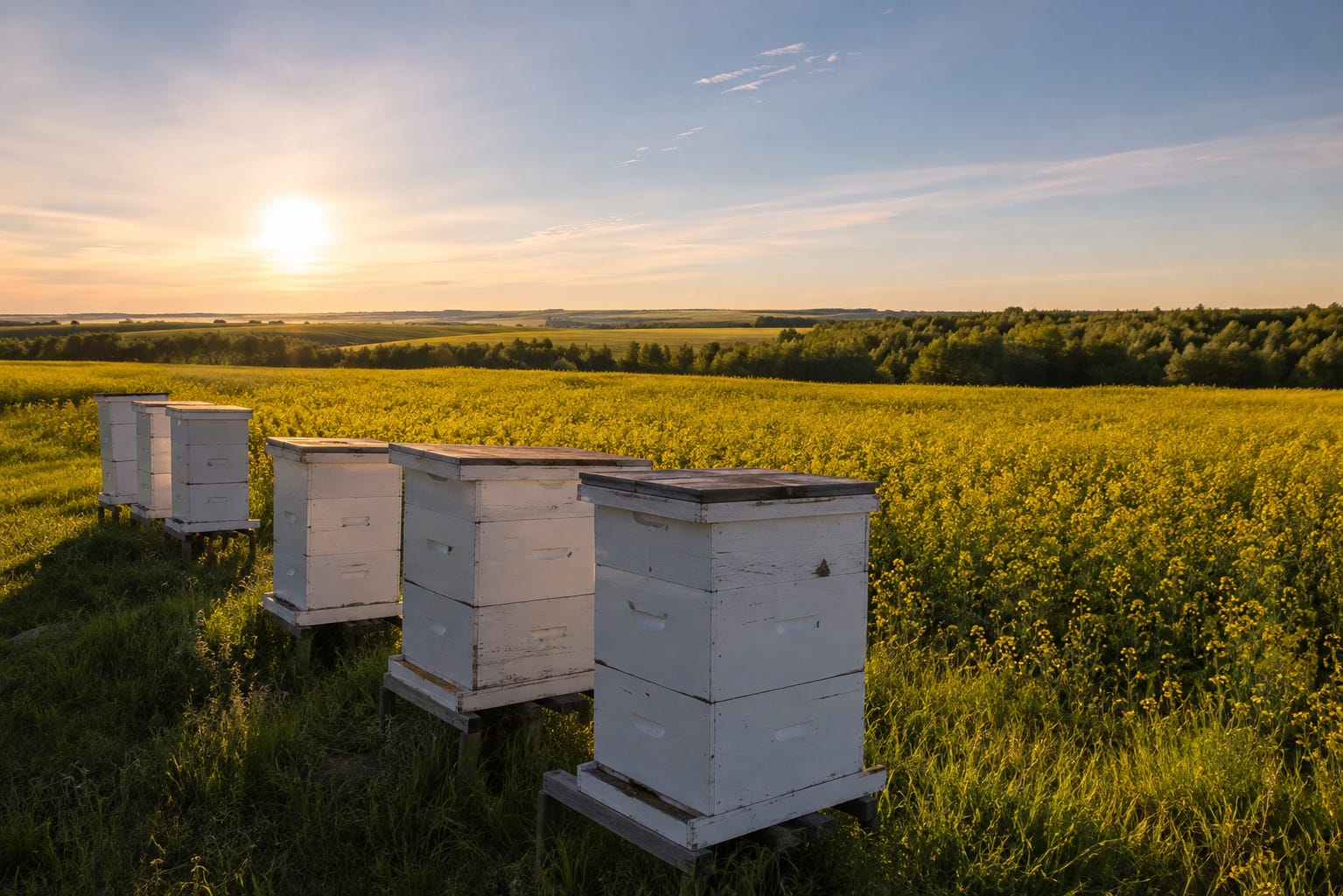
At ten o’clock on a July evening near Fort Vermilion, AB, the sun still stands above the poplars and the bees are still working. The Peace country sits at fifty-eight degrees north, well above Moscow and level with Juneau, Alaska. Beekeepers do push further north than that: Norwegian producers work between roughly sixty and sixty-one and a half degrees, and a Russian hobbyist above the Arctic Circle keeps forty hives and holds the latitude record. Nobody up there, though, keeps bees for a living at anything like this scale. The most northerly commercial honey industry on earth is Albertan, and it is also the most productive in North America. The geek in me thinks that’s cool.
Bees caught me by accident. The NS ban lingering on my mind and a stray curious question about Canadian honey sent me into the Statistics Canada tables, and every answer the tables gave up raised a better question (as tends to be the case). How does the province with some of the harshest winters on the planet make the most honey? Why do British Columbia and Ontario, holding two-thirds of the country’s beekeepers between them, produce barely a seventh of the crop? What follows is what I learned chasing those questions, and why the Alberta chapter kept stealing the country’s book.
The evidence paints the result plainly. Statistics Canada has counted honey since 1924, and across those hundred and two years Alberta has finished first sixty-four times, including every single season since 1986. Forty consecutive years at the top. (Manitoba borrowed the crown once in 1985 and never got it back.)
In 2025, Alberta produced 34 million pounds, roughly a third of the country’s crop, the work of 1,630 beekeepers running just over 200 hives each, triple the national average. Alberta out-produces the entire non-Prairie country every single year. This was all new to me. I was surprised I hadn't run into it before.
Which brings me back to the second question, the one about the coasts. British Columbia and Ontario have the beekeepers. They do not have the honey. Between them, the two provinces hold 65 percent of the country’s beekeepers and only 24 percent of its colonies because most of those beekeepers are hobbyists and sideliners tending a dozen or two hives apiece rather than commercial operators running hundreds. Their bees also work a different job.
Coastal and Ontario colonies earn much of their keep as rented pollination labour (worker bees!), trucked to blueberries, cranberries, and orchards at 120 to 150 dollars a hive, with honey as a sideline; Ontario shipped 22,792 colonies east in 2025 just to pollinate Maritime and Quebec berry fields. Prairie hives stay home and fill supers (extra space for bees to store their honey). The resulting yield gap startled me when I ran the arithmetic.
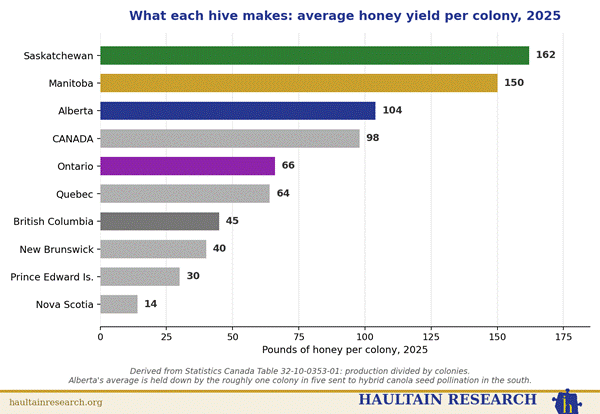
Average honey yield per colony, 2025, derived from Statistics Canada Table 32-10-0353-01. Chart: Haultain Research.
Saskatchewan tops that chart, and the reason is instructive. Saskatchewan has no coastline, no orchards, and almost no pollination contracts to speak of, leaving its 92,000 colonies with one job all summer: making honey in canola and clover country.
Manitoba runs the same model and lands just behind. Alberta’s 104 pounds looks modest by comparison, and the explanation sits in the south. Somewhere between 55,000 and 80,000 Alberta colonies, roughly one in five, are trucked each summer into the hybrid canola seed fields around Lethbridge, the largest pollination market in Canada. Those hives are managed to move pollen between parent lines rather than to fill supers, and they drag the provincial average down while earning their keep in a different currency. Alberta’s per-hive figure understates its bee pasture; the province simply asks more of its bees than honey.
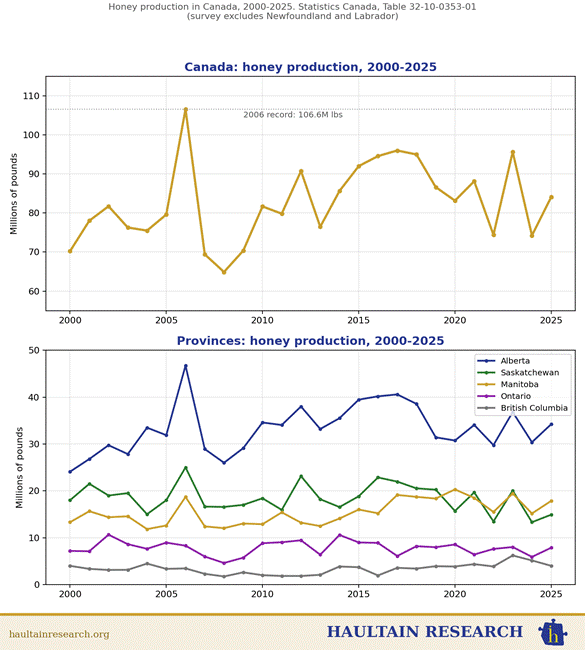
Honey production, 2000-2025, national and by major province. Source: Statistics Canada, Table 32-10-0353-01 (StatsCan survey excludes Newfoundland and Labrador). Chart: Haultain Research.
Follow the yellow national line in the graph above, and you watch a golden age die abruptly in a single winter. In 2006 the country brought in a record 106.6 million pounds, and Alberta alone accounted for 46.7 million of them, a provincial haul never matched since. Then the floor gave way: the crash that followed cut the country by a third in a single season and cut Alberta by eighteen million pounds; the mite discussed below is responsible.
The line never climbs back. For two decades it saws between recovery and relapse, and the recent teeth are the sharpest, with the hard winters of 2022 and 2024 each erasing a fifth of the national crop; the 2024 fall was the steepest since the original collapse. Beneath all that turbulence, one thing never changes. The blue Alberta line rides above every other, in all twenty-six years, without exception.
My first real surprise came from the canola fields. From all that I had ever read, farm monocultures are usually a famine for bees, mile after mile of a single crop that blooms briefly and feeds them nothing the rest of the season. Canola is the great exception: its flowers run rich in nectar and protein-heavy pollen, and Alberta plants millions of acres of it, blooming in one synchronized yellow flood just as hives reach their summer population peak.
The northern light also puzzled me until I understood how a honey crop forms. Alberta’s season is short, and there is no getting around that: hives break their winter cluster in April, and the serious nectar flow lasts perhaps six or eight weeks, from late June into early August. A hive in a mild climate has months more calendar. What it lacks is a flow like this one. Honey is not a function of how many days a colony can fly; it is a function of how much nectar arrives while the colony is at full strength, and a Prairie hive meets its flood at exactly the moment it holds sixty thousand foragers. An eighteen-hour June day at Fort Vermilion then gives each of those bees four or five more working hours than California or Ontario can offer. Short season, enormous flow, long days: the calendar loses, and the arithmetic wins.
Dry Prairie air finishes the job. It keeps the bees flying, cures the nectar quickly, and starves the moulds and brood diseases that thrive on the humid coasts. The result is the premium white honey that Japan, the most contamination-averse food market on earth, buys by the tonne. Industrial agriculture built the pollinator boom.
Haultain Research is a reader-supported publication. To receive new posts and support our work, consider becoming a free or paid subscriber. You may also support us by sharing our work with like-minded friends and family, or making a modest donation at haultainresearch.org
The dataset's villain, a mite, took some reading to understand, and its biography is stranger than I expected. A mite is not an insect but an arachnid, a cousin of the tick and the spider, and Varroa destructor is roughly the size of a pinhead: on a honey bee it rides about as a dinner plate would ride on a man’s back. It began as a parasite of the Asian honey bee, which spent a very long time learning to live with it. Asian workers groom mites off one another and bite them; when a mite slips into a brood cell to breed, the colony detects the infested pupa, tears open the wax cap, and destroys the brood and the parasite inside it. The bees lose a few of their young and keep the mite population down to a nuisance.
Our Western honey bee never learned any of that. When infested colonies were shipped into Europe in the early 1970s, the mite jumped to a host with no grooming reflex, no capacity to detect infested brood, and no instinct to open the cells. It crossed the oceans with the bee trade and first appeared in New Brunswick in 1989. What it does was misunderstood for fifty years: scientists assumed it sucked blood like a tick, until a 2019 study in the Proceedings of the National Academy of Sciences showed it actually eats the bee’s fat body, the organ that works like a liver and stores the reserves a colony needs to survive five months of winter confinement.
The feeding wound doubles as a syringe. Viruses that would otherwise smoulder harmlessly in a hive travel on the mite and enter the bee’s bloodstream directly, and one of them deforms wings so badly that young bees emerge unable to fly. Beekeepers fought back with synthetic miticides, and the mite, which turns over a generation in a fortnight, evolved around each one within a few years.
So the record colony counts of the past two decades conceal a weaker animal, and each spring the industry rebuilds what winter took. Canadian beekeepers import some 300,000 queens a year, better than eight in ten of them from California and Hawaii, at roughly forty dollars apiece at the border, and they fly in package bees by the tonne from New Zealand, Australia, Italy, and Chile.
Why California, I wondered? Geography again, and this time the advantage runs the other way. A queen must mate on the wing in warm air, and no corner of Canada can stage a mating flight in February or March, exactly when Prairie beekeepers open their hives and count the winter dead. The California Central Valley can. What California sells to Canadians is less the insect than the calendar, and raising queens here in volume would help little against that arithmetic.
The dependency still contains one irony built for Prairie readers. The most promising winter-hardy, mite-resistant genetics in the world were bred in Saskatchewan, selected by putting colonies under mite pressure without chemicals and breeding the survivors. The hybrids are then mass-produced under an exclusive arrangement in northern California and sold back to the Prairies each spring. Saskatchewan supplies the genius; the Sacramento Valley collects the margin.
None of this offends me, and it should not offend anyone who has thought about it for ten minutes. The arrangement is what a continent looks like when its parts do what each does best. Alberta’s canola cannot be grown in the Sacramento Valley; a Sacramento queen cannot be mated in Fort Vermilion in February. The hives on Highway 3 hold both halves of that bargain at once.
The trade ledger held one more surprise, with a sting. Canada exports about a quarter of its honey, and the buyers are concentrated: the United States took 63 percent of 2024 shipments by volume and Japan another third. Japan is the more interesting customer of the two. It is the largest honey importer in Asia, buying some 45,000 tonnes a year against a domestic crop that covers barely six percent of what its people eat, and it pays for quality. Canada supplies only about one Japanese pound in twenty, well behind China, but that trickle earns 44 percent of our export dollars while accounting for 33 percent of our export volume. Japanese buyers paid nearly three dollars a pound for Canadian honey in 2024, while the American price sat closer to two and a half.
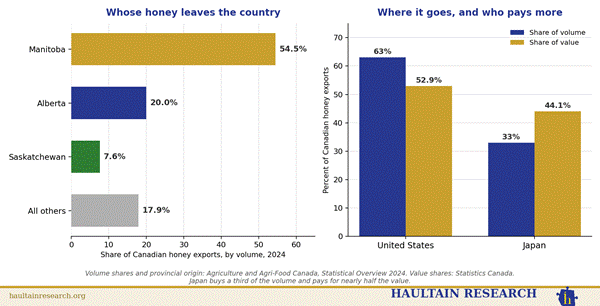
Canadian honey exports by province of origin and by destination, 2024. Sources: Agriculture and Agri-Food Canada, Statistical Overview 2024; Statistics Canada. Chart: Haultain Research.
Look at the left panel and the tariff question answers itself. Manitoba is the export champion of Confederation, shipping over half of Canada’s exported honey and nearly two-thirds of its own production abroad, with Alberta a distant second at a fifth. So when Washington put honey on its 50 percent tariff list this year, the blow did not land evenly across the country. It landed on Manitoba. Manitoba’s honey exports were worth $28.79 million in 2024 against Saskatchewan’s $3.67 million, and the great majority of that Manitoba honey crosses the border south.
Premier Wab Kinew has been among the most enthusiastic voices for escalation, pulling American liquor from Manitoba shelves, backing Ottawa’s withdrawal from trade talks without reservation, and telling reporters that Canada should never appease the American president but fight back. A premier is entitled to that view. What he is not entitled to is the pretence that the bill lands somewhere else. Retaliation is decided in Ottawa and cheered in Winnipeg, and paid for, in this instance, by roughly a thousand Manitoba beekeepers whose product is now the most tariff-exposed sweet commodity in the country. The sweetest corner of Prairie agriculture doubles as a live exhibit in the tariff wars.
Something larger than agriculture also hums in those hives, and this discovery reframed the whole file for me. Environmental science formally deputizes the honey bee as a biomonitor: a colony operates as tens of thousands of airborne sampling devices, and every kilogram of honey represents more than 100,000 foraging flights through the surrounding country. Federal scientists published the case for bees as living environmental sensors in the journal Ecological Indicators in 2022.
By that standard, Alberta submits roughly thirty-four million pounds of favourable environmental evidence annually. A province that radical environmentalists would routinely have people believe is an ecological sacrifice zone accelerating the end of the world leads the continent in a product that functions as a distributed environmental assay, holds record colony counts, and clears the food-safety standards of Japan, the world’s fussiest importer. A wasteland does not do this.
The finding comes with limits. The bees acquit the province, rather than the oil sands mine perimeter. The mineable oil sands sit in the northeastern boreal forest around Fort McMurray; the bee belt runs through the Peace country, the central parkland, and the southern irrigation districts, hundreds of kilometres from the nearest tailings pond. Alberta’s own environmental tally puts the disturbed mining area near 900 square kilometres, little more than a tenth of one percent of the province.
Before anyone reaches for the obvious retort, apply it evenly. Pick whatever Alberta industry the critics consider greenest, and ask how many hives it supports within a kilometre of its operations. A wind farm produces no nectar. A solar array produces no nectar. A hydro reservoir produces no nectar. No industrial site of any kind feeds bees, which live on flowering plants and farmland, so the absence of hives beside a mine tells you where the flowers are and nothing whatever about what the mine emits. Provincial-scale evidence answers the provincial-scale slander, and answers it decisively. It says little about conditions within the foraging radius of the mines, because almost no hives sit there, and no one has yet put any there to find out.
That gap is a standing invitation, and the fairer version of the test is already sitting in plain view. Oil sands operators have reclaimed thousands of hectares of mined land and seeded it back to boreal cover, and reclaimed ground grows flowers. Put hives on it. Run a second line of instrumented colonies from Fort McMurray down to the Peace, assay the pollen, honey, propolis, and the bees themselves for hydrocarbons and heavy metals, and publish whatever comes back. The method is settled, and the cost is trivial beside what both camps spend on advertising. One season would settle what a decade of duelling adjectives has not. The reader may wonder why neither side of the oil sands debate has hurried to fund it.
Despite doomsday charges against Alberta and its energy and ranching industries, the Alberta environment is propitious and welcoming to these tiny canaries in the supposed contaminated coal mine that the radical environmentalists see in Alberta. Next time you hear/read someone tell you, and they will, that Alberta is an environmental wasteland, tell them about our bees.
The verdict writes itself at fifty-eight degrees north. Alberta’s story is sweet precisely where its critics insist it is toxic, and the proof works the canola under the midnight sun. The copious, coveted honey is the receipt.
Terrific research, Marco. I hope this gets the coverage it deserves.
Thank you for all the research you did. One question: why can't bees be imported into NS? And now we have this excellent post. It give me hope.and it also makes me wonder if the 50% tariff on honey was a special "gift" to kinew. People think trump is stupid.