


On the evening of December 14, 1999, the last car rolled off the ferry Coho at Port Angeles, Washington. The driver handed over a Quebec licence identifying him as Benni Noris of Montreal. A customs inspector named Diana Dean thought he seemed jittery, asked him to open the trunk, and found more than a hundred pounds of bomb chemicals, a jar of nitroglycerine mixture, and four timing devices. Benni Noris was Ahmed Ressam, an Algerian recruited by al-Qaeda while living in Montreal. His target was Los Angeles International Airport on the eve of the millennium.
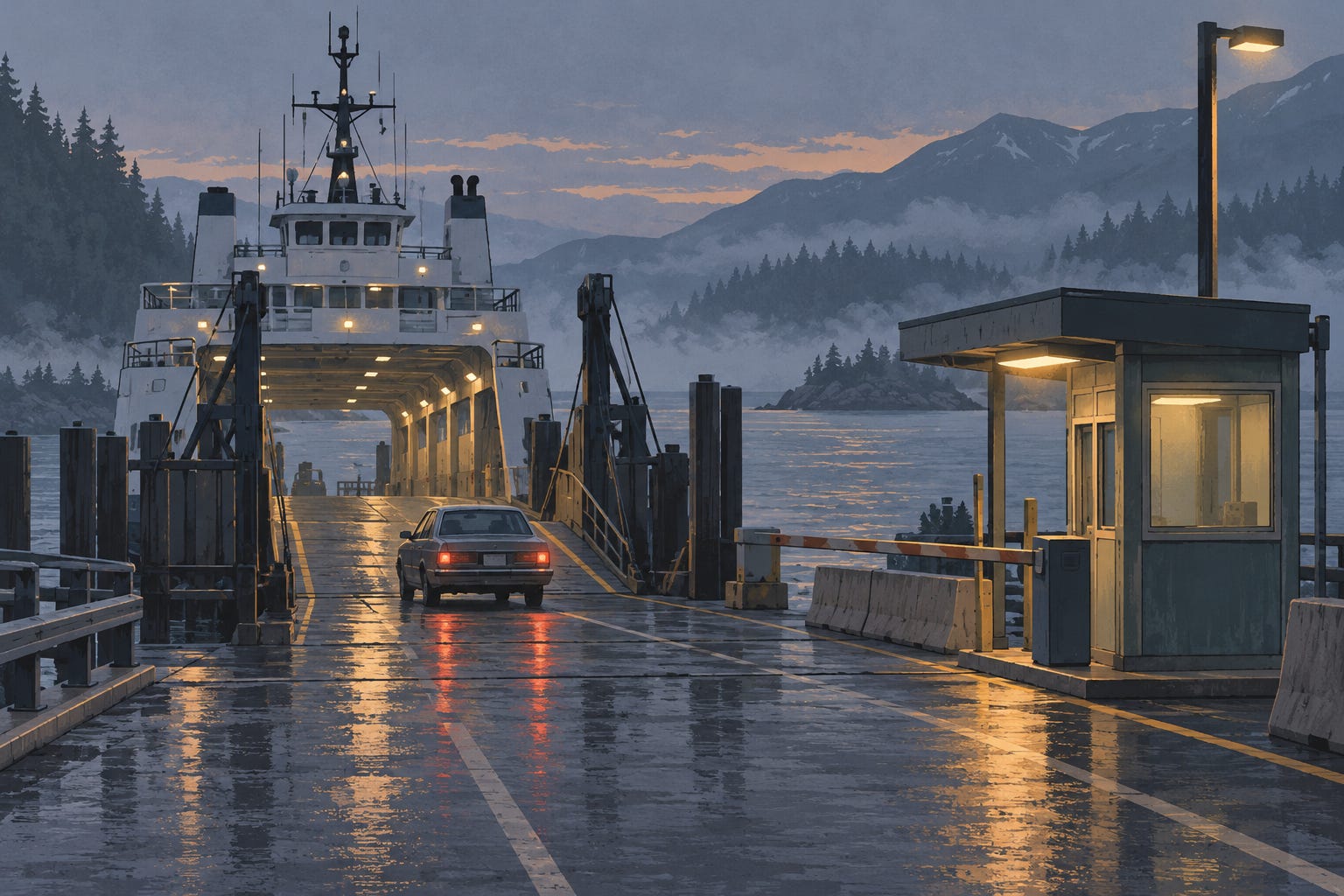
Everything about the case except the arrest was Canadian. Ressam had arrived in 1994 on a French passport that officials identified as fake on sight. He stayed by claiming asylum. The claim failed in 1995; the appeal failed in 1996; the deportation order was never executed. Some things have not changed. CSIS had watched him as part of its investigation of a suspected Montreal extremist network. In March 1998, using a Canadian passport obtained under a false identity, he left for terrorist training camps in Afghanistan. He returned under that identity in February 1999. He cooked his explosives in a Vancouver motel and drove to the Victoria ferry. Within thirty seconds, an alert American inspector had seen enough to order the secondary search that exposed what five years of Canadian process had not.
That was an isolated incident, right? Perhaps not. Canada is a country persuaded that terrorism merely passes through it, so it may never examine itself honestly. That is the Canadian condition, and it has now lasted more than half a century. On this 25th anniversary of the attack on the Twin Towers, it might be propitious to examine the record as a way to honour the two dozen Canadians who died there.
The United States answered September 11 with a public, adversarial, document-driven commission that named its own institutional failures in print, under oath, for posterity. Canada, whose territory staged the nearest miss of the pre-9/11 era, held nothing. No commission examined what Canadian agencies knew about the Montreal networks, when they knew it, or why a man with a rejected refugee claim and a surveillance file boarded a ferry with a bomb. An American courtroom in Seattle assembled the accounting that now exists.
The reflex behind that omission surfaced again only a few days ago. Ahead of the 9/11 twenty-fifth anniversary, which is today, a memo from CBC News instructed journalists, in bold type, not to refer to the September 11 attacks as terrorist attacks; the approved formulation described hijackings that led to passenger jet crashes. After condemnation from the FBI director, the American ambassador, and Canadian ministers and opposition alike, the memo’s author, standards chief Basem Boshra, reversed the guidance on a Friday afternoon, conceding it had become an impediment to clarity and public understanding. The episode lasted four days and will likely be forgotten before Thanksgiving. But we should try to remember it because the memo is a small window into a larger habit.
The case for the defence
Attribution is a legitimate journalistic principle. The BBC, the Associated Press, AFP, and Reuters all counsel caution with the word terrorism because governments the world over abuse it to smear opponents, and a broadcaster that hands out the label freely will soon be handing it to whoever holds power. CBC’s editor-in-chief made that argument accurately in 2023. Nor was Canada attacked on September 11. Its 9/11 stories were real and were covered at length: Gander’s improvised hospitality to thousands of stranded passengers; a war in Afghanistan that cost 158 Canadian soldiers their lives; the Arar inquiry, which investigated Canadian complicity in the rendition and torture of a citizen and produced reform and compensation. On this reading, Canada owed nobody a commission because it failed to examine anything. The planes did not come down here.
Ressam alone destroys the premise. But he does not stand alone. Set the record out from October 1970 forward, and the premise collapses under its own weight.
The record
The FLQ opened the modern era with roughly two hundred bombings, culminating in the kidnappings of James Cross and Pierre Laporte and Laporte’s murder in October 1970. In the following decade, Ottawa’s diplomatic quarter became a hunting ground. Armenian gunmen shot and paralyzed the Turkish commercial counsellor Kani Gungor in April 1982; that August they assassinated Colonel Atilla Altikat at a red light on the parkway, the only murder of a foreign diplomat ever committed on Canadian soil, which has never been solved. In March 1985, three gunmen stormed the Turkish embassy and killed the security guard on duty, Claude Brunelle, a thirty-one-year-old student.
In October 1982, the anarchist cell Direct Action drove a stolen van loaded with 550 kilograms of dynamite from Vancouver to Toronto and blew apart the front of the Litton plant that built cruise missile guidance components, injuring eleven people, including five employees, three police officers and three motorists. In September 1984, a pipe bomb in a luggage locker at Montreal’s Central Station killed three French tourists in the week before a papal visit.
Then came June 23, 1985. Air India Flight 182, destroyed off the Irish coast by a bomb built and loaded in British Columbia, killed 329 people, most of them Canadian citizens. It remains the largest mass murder in Canadian history, and Canadian institutions spent two decades processing it as a foreign tragedy. The public inquiry arrived in 2006, twenty-one years late, and Justice John Major summarized his findings as a cascading series of errors.
The extremist file around it kept producing warnings that went unheeded. When gunmen ambushed the visiting Punjab minister Malkiat Singh Sidhu on a Vancouver Island road in May 1986, authorities had received clear information about the plot two days earlier; it sat unrelayed over a weekend. Tara Singh Hayer, the Surrey publisher who condemned the bombers within his own community and offered to testify, was shot and paralyzed in 1988 and assassinated in his garage in 1998, the first journalist killed in Canada for his work. No one has been convicted.
The 1990s added a campaign that Winnipeg police themselves called terrorism against doctors: three physicians shot through the windows of their homes, in Vancouver in 1994, Ancaster in 1995, and Winnipeg in 1997, each around Remembrance Day. The American anti-abortion militant James Kopp, convicted of the identical murder of a Buffalo physician, remains the prime suspect in all three. Canada never charged him.
Then Ressam, and then the jihadist era he foreshadowed. Momin Khawaja of Ottawa became the first person convicted under the Anti-terrorism Act in a plot tied to a British fertilizer bomb. The Toronto 18 assembled truck bombs and a plan to storm Parliament in 2006. An al-Qaeda-directed cell plotted to derail a Via Rail train in 2013. In October 2014, two attacks in three days killed Warrant Officer Patrice Vincent at Saint-Jean-sur-Richelieu and Corporal Nathan Cirillo at the National War Memorial, and the killer then entered Centre Block with a rifle. Aaron Driver detonated a device in a Strathroy taxi in 2016 on his way to an attack. In July 2024, the RCMP arrested a father and son in a Richmond Hill hotel with an axe and a machete, in what the force called the advanced stages of planning mass murder for ISIS; the father also faces the first war crimes charges ever laid in a Canadian national security case.
The domestic ideological ledger has also been long. The Quebec City mosque shooting of January 2017 killed six worshippers at prayer and was prosecuted as murder, never as terrorism. The Toronto van attack of 2018 killed ten pedestrians. The London attack of June 2021 killed four members of the Afzaal family on an evening walk, and did produce a terrorist murder conviction. An armed man rammed the gates of Rideau Hall in 2020 in search of the prime minister. In July 2025, the RCMP charged three Quebec men, two of them serving soldiers, with facilitating terrorist activity in a plot to seize land near Quebec City and raise an anti-government militia; an earlier raid had gathered sixteen explosive devices, eighty-three firearms, and eleven thousand rounds.
Since October 2023, Jewish schools in Montreal and Toronto have repeatedly been struck by gunfire, while synagogues and other Jewish institutions in Montreal and Vancouver have been attacked with incendiary devices. Many cases remain unsolved; authorities have generally investigated those with identified suspects under ordinary firearms, arson or hate-crime provisions rather than terrorism law.
The habit
In half a century, every decade has been supplied, and every ideology represented. Yet the incidents live in public memory as disconnected curiosities: a crisis here, a cold case there, a near miss somewhere else. The thread connecting them is institutional conduct. In case after case, the sequence repeats: prior awareness, then inaction, then no reckoning. CSIS surveilled the Air India plotters before the bombing and Ressam before the millennium plot. The Sidhu warning sat in an in-tray over a weekend. Kopp was identified and never charged. The mosque shooter was never charged as a terrorist. And when the record demanded a national accounting, officials deferred it (Air India), outsourced it (Ressam, tried and debriefed in Seattle), or declined it outright (the entire pre-9/11 file).
Externalization is the country’s habit. Canadian institutions treat political violence the way one treats weather from elsewhere: it blows through, it belongs to other people’s histories, and nobody audits the sky. The bookkeeping is asymmetric in a revealing way. What arrives is minimized, and what Canada exports never enters the ledger. The deadliest aviation bombing before 9/11 departed from Canadian soil. The last al-Qaeda plot against America before 9/11 was staged from Montreal.
A 2024 plot against a Brooklyn Jewish centre was staged from Canada again. None of it disturbs the national self-image because the victims fell elsewhere, and a harm that lands elsewhere gets filed as someone else’s history. The CBC memo belongs to the same ledger: language held at tweezers’ length from events, so that the events never quite become ours. Why do we believe that these things are best held in oblivion?
The remedy
The prescription follows from the diagnosis. First, Parliament, were it sitting, could mark the anniversary by commissioning what was never done: a review, armed with the power to compel documents, of the pre-9/11 file, beginning with what CSIS and the RCMP knew of the Montreal networks and why a man under a deportation order assembled a bomb on Canadian soil. The Air India precedent proves that an inquiry two decades late can still tell the truth. Second, Ottawa must assign more resources and become more vigilant about who it lets into the country and prosecute/deport gangsters and foreign criminals. Third, prosecutors should apply the terrorism provisions of the Criminal Code with visible consistency, so that the label ceases to depend on the identity of the victim or the accused. Fourth, public institutions should speak plainly. The CBC found its way to plain speech within four days, once the cost of evasion exceeded its comfort. The rest of the state can be held to the same arithmetic.
The twenty-four Canadians who died in the towers 25 years ago deserve more than a style guide. So do the 329 of Flight 182, the travellers who never knew how close the millennium came to opening with a massacre, and the schoolchildren in Montreal and Toronto who now pass bullet marks on their way to class.
A country defends itself first with words that match the facts, and then with institutions willing to be examined. The postmodern impulse is to forget and look away from troublesome past events. What a country refuses to name at home, it invites again; what it audits honestly, it can begin to prevent. Fifty-six years after the October Crisis, the audit is still owed.
You do describe that oh-so-smug Canadian way; but sadly I see no sign of change happening any time soon.
OMG. When you lay it out like that it certainly shines a light where the sun doesn't shine.
Thank you.