


The Haultain Brief is a weekly compilation of the news that matters for Alberta and Western Canada. Each Wednesday, we cover the prior week’s political, economic, energy, legal, and institutional developments, organized by theme, with links to primary sources. The editorial perspective will be familiar to Haultain Research readers: evidence-driven, skeptical of fashionable orthodoxies, unapologetically Western Canadian. The Brief complements rather than replaces the longer analytical essays published here. If you find it useful, consider a paid subscription to support the work.

Intergovernmental Affairs
Ottawa starts the clock on a national interest designation for the West Coast pipeline
A Canada Gazette notice issued on the Saturday of the long weekend began designating the proposed Alberta to British Columbia oil line a national interest project under the Building Canada Act, the federal statute that fast-tracks major projects. Comment closes 18 September.
Why it matters: The line would run about 1,250 kilometres from Bruderheim, northeast of Edmonton, to a deepwater port near Delta, British Columbia, carrying roughly a million barrels a day. Trans Mountain Corporation (the federally owned pipeline company), the Alberta Petroleum Marketing Commission (the province’s crude marketing agency) and Pembina Pipeline Corporation (the Calgary energy infrastructure company) would form a jointly owned entity to build it. At Haultain Research we have argued for years that Alberta’s single largest economic vulnerability is egress, and this is the most serious federal move on it since 2018. But a designation that shortens timelines by shortening process buys speed at the cost of durability. The Gazette notice is the easy part. What determines whether shovels move in 2027 is the consultation record now being built.
Canada Gazette, Part I, “Notice, West Coast Oil Pipeline”, 1 August 2026; ownership terms via Calgary Journal, “Ottawa moves to list Alberta-backed West Coast pipeline as national interest project”, 4 August 2026.
B.C. chiefs tell Carney and Smith the consultation is not real
The Union of British Columbia Indian Chiefs, that province’s oldest First Nations political organization, wrote to the Prime Minister and the Premier on Sunday demanding the pipeline be halted, arguing the route, partners and economic case were settled before anyone was consulted.
Why it matters: The operative sentence is precise: “Consultation cannot be meaningful if First Nations are invited only to discuss how a predetermined project will proceed.” At Haultain Research we recognize the court-imposed duty to consult, and the practical case for meeting it properly is the same as the legal one: consultation done badly is the most reliable way to lose a pipeline in court, as Northern Gateway demonstrated in 2016. Ottawa and Edmonton have five weeks of comment period to build a record that survives judicial review. That is the whole project.
Union of British Columbia Indian Chiefs, open letter on wildfires and floods, 9 August 2026; reported by EnergyNow, 9 August 2026.
Politics & Government
Smith tells police to stop enforcing hate speech law
After the Edmonton Police Service posted a video urging the public to report hate, Premier Danielle Smith said Alberta will not police “unpopular or religious-based statements even if they are controversial,” and told her public safety minister to redirect police priorities.
Why it matters: Two things happened here and they deserve separate verdicts. The first is defensible: the criminal threshold for hate propaganda is high, and a police service publishing a list of reportable opinions invites the chilling effect critics feared. The second is a governance problem. Smith reportedly said: “The federal government does have the power of criminal law. We have the power of non-enforcement.” At Haultain Research we think a premier instructing an operationally independent municipal police service on which Criminal Code provisions to ignore is a precedent Albertans are forced into. Bill C-9 is bad law from a fabricated majority in Parliament, which does not account for regional cultural differences. Do not build a convention where provinces enforce federal criminal law selectively to please voters in particular regions of the country.
Medicine Hat News, “Premier calls out police force for anti-hate campaign”, 6 August 2026; APTN News, “Alberta premier posts video on her government’s stance on free speech”, 6 August 2026; Western Standard, “Edmonton Police Service scrubs part of its controversial ‘hate crimes’ examples”, 7 August 2026.
Supreme Court will hear Alberta’s appeal on the lawyers’ oath to the King
The Supreme Court of Canada will hear Alberta’s appeal of a December 2025 Court of Appeal ruling that the Oath of Allegiance required of new lawyers unjustifiably infringes religious freedom. Prabjot Wirring, an Amritdhari Sikh, brought the challenge in June 2022.
Why it matters: This is the courts working exactly as they should. A century-old statutory requirement was tested against the Charter, an Alberta court found it could not be justified, and it offered the legislature three ways to fix it: make the oath optional, remove it, or reword it. Ontario, Nova Scotia, New Brunswick and Yukon have already made the oath optional, and British Columbia, Saskatchewan and Prince Edward Island have eliminated it, so this is neither novel nor destabilizing. At Haultain Research we hold that judicial enforcement of constitutional limits is the rule of law functioning. What is harder to defend is Alberta’s choice to spend public money appealing to Ottawa’s highest court over a formality its own legislature could amend in an afternoon.
Global News, “Supreme Court to hear case on constitutionality of requiring oath to the Crown”, 6 August 2026; Western Standard, “Supreme Court to hear challenge of Alberta lawyers’ oath to King”, 7 August 2026.
The nine referendum questions nobody is talking about
Alberta’s 19 October ballot carries ten questions: five on immigration, four on constitutional change, and the separation question added last. Edmonton lawyer Avnish Nanda, co-founder of the pro-immigration group Our Alberta Advantage, calls the immigration questions harmful and unnecessary.
Why it matters: The immigration questions contemplate withholding health care, education and social services from people who lack Canadian citizenship, permanent residency, or an “Alberta-approved immigration status” that does not currently exist. At Haultain Research we take seriously the argument that Alberta absorbs population growth it did not choose and cannot fund, and Smith’s line that “not every newcomer is a net contributor” is defensible as fiscal accounting. But a referendum question is not a policy. These proposals are part and parcel of the grassroots traditions of Prairie politics. What voters endorse in October, the province must then actually be able to build, and on that question the ballot itself is silent.
Global News, “Alberta lawyer says referendum questions about immigration ‘harmful,’ ‘unnecessary’”, 5 August 2026.
Energy & Resource Development
Canadian Natural is holding 340,000 barrels a day in reserve until Ottawa signs
Alberta’s largest producer reported record second quarter results and, in the same release, disclosed that four growth projects totalling roughly 340,000 barrels a day stay on hold until definitive agreements under a trilateral memorandum with Alberta and Ottawa are finalized.
Why it matters: The deferred projects are specific and large: 30,000 barrels a day at Jackfish, 70,000 at Pike 2, 150,000 at a new Jackpine mine at Albian, and 90,000 in extraction and froth treatment upgrades at Horizon. This is the most important number in Alberta this week and it appeared almost nowhere outside the trade press. At Haultain Research we read it as a clean measurement of what policy uncertainty actually costs: not a think tank estimate, but a company with record cash telling its shareholders in writing that it will not deploy capital until governments finish a document. November is now a real deadline with a quarter of a million barrels a day attached to it.
Canadian Natural Resources Limited, “2026 Second Quarter Results”, 6 August 2026; Daily Oil Bulletin, “CNRL growth projects remain on hold until trilateral MOU finalized”, 6 August 2026.
A new panel to look at a compensation bill taxpayers keep paying
Service Alberta and Red Tape Reduction Minister Dale Nally appointed a Surface Rights Advisory Panel, chaired by Kris Bower of the land firm 2G Land Ltd., to review how landowners are compensated when energy companies stop paying rent on their land.
Why it matters: The numbers are the story. The Land and Property Rights Tribunal, which absorbed the old Surface Rights Board in 2021, took about 9,000 surface rights applications in 2025 and 2026, the most on record, and the province paid landowners more than $44 million, up from $29.8 million the year before. That is a taxpayer backstop for unpaid private obligations, and it is growing fast in a year when producers are reporting record profits. At Haultain Research we would ask of any new body what it replaces, who it answers to, and how anyone would know if it failed. On the public record so far, the panel’s size, budget, reporting line and deadline are not stated.
Red Deer Advocate, “Alberta establishes new surface rights advisory panel”, 6 August 2026.
The Haultain Brief is compiled by Haultain Research staff and is a reader-supported publication. To receive new posts and support our work, consider becoming a free or paid subscriber. You may also support us by sharing our work with like-minded friends and family, or making a modest donation at www.haultain.org
Economy & Finance
Record profits, falling production: the windfall is a price story
Suncor Energy reported second quarter net earnings of $3.732 billion, more than triple the $1.134 billion of a year earlier, on upstream production that fell to 760,900 barrels a day from 808,100. Canadian Natural posted $4.5 billion. Price, not volume.
Why it matters: Writing on the industry site EnergyNow, William Lacey calculated that Canadian Natural, Cenovus, Imperial Oil and Suncor together paid about $15.5 billion in royalties and taxes in the first half of 2026, against $9.2 billion in the same period of 2025. That is an enormous number and it is entirely a function of the Strait of Hormuz disruption. Brent and West Texas Intermediate both fell more than seven per cent in the week just ended on nothing more than progress in negotiations to reopen the waterway. At Haultain Research we would treat every dollar of this windfall as non-recurring until proven otherwise. A budget built on a blockade is a budget built on a ceasefire it does not control.
Suncor Energy via BOE Report, “Suncor Energy reports second quarter 2026 results”, 4 August 2026; EnergyNow, “Commentary: the royalties and taxes being paid by the Canadian upstream sector”, 7 August 2026.
Business & Investment
Data centre consultation arrives after the announcement
Hundreds protested outside the Sturgeon County office at Morinville on Sunday against Meta’s proposed data centre north of Edmonton, a project the province values above $13 billion. Four days later, the government announced four town halls and an information website.
Why it matters: The sequence matters. The project was announced in July, the protest came in August, and the consultation was scheduled after that. At Haultain Research, we think the town halls are the right call and the province deserves credit for scheduling them rather than dismissing the objection, but arriving third in that order costs credibility that meetings do not fully recover. The substantive questions are answerable and specific: who pays for the transmission the load requires, whether existing ratepayers are exposed if a hyperscaler leaves, and what the site actually draws. Premier Smith says the facility uses closed-loop cooling and less water annually than a golf course. That claim is checkable, and the town halls are the place to check it.
Lethbridge News Now, “Alberta government announces town hall series, new website on AI data centres”, 7 August 2026; Government of Alberta, AI data centres; protest reported by 980 CJME, 3 August 2026.
Labour & Employment
WestJet and its flight attendants settle in a day
A strike by roughly 4,400 WestJet flight attendants represented by CUPE Local 8125 began early on Sunday and produced a tentative agreement by Monday. The three-year contract runs to December 2028; the bargaining committee unanimously recommends ratification.
Why it matters: A long weekend strike at Canada’s second largest airline ended in about thirty-six hours through collective bargaining, without back-to-work legislation, ministerial referral, or a federal intervention of any kind. At Haultain Research, we note this because the opposite outcome has become the norm: three of the last several major Canadian transport disputes were resolved by Ottawa rather than by the parties. The central issue, compensation for cabin crew hours worked on the ground, is a genuine grievance about how airline pay has been structured for decades, and the parties fixed it themselves. Members have not yet voted, and the wage terms remain undisclosed. But the process worked, and that deserves saying.
CUPE, “Union launches ratification process on tentative agreement with WestJet”, 7 August 2026; CP24, “WestJet, CUPE reach tentative agreement”, 3 August 2026.
Health
Alberta’s pay your own way scans meet an arithmetic problem
Alberta’s new self-referral program lets patients book diagnostic imaging without a doctor’s requisition if they pay, with reimbursement only if the scan finds a previously undiagnosed cancer. Technologists say the province is short about 202 positions, with the shortfall doubling by 2028.
Why it matters: The policy premise is not unreasonable. Waiting for a requisition is itself a rationing mechanism, and people who want to buy a scan currently drive to another province to do it. But a shortage of technologists is a hard constraint that no payment model relaxes. Gina McRae of the Canadian Association of Medical Radiation Technologists put it plainly: “We’re very curious about how we’re going to be able to meet the new demands as more and more people are able to self-refer.” At Haultain Research, we would want the province to publish, quarterly, what happens to publicly funded wait times as private volume grows. If they lengthen, the policy is shifting queue position rather than adding capacity, and that is a different thing from what was advertised.
Global News, “Clinics, technicians unsure of Alberta’s new self-referral method for health tests”, 6 August 2026.
Agriculture & Agrifood
The cattle rally meets the consumer
Alberta packers cut dressed bids by $8 to $15 per hundredweight, to $535 to $542, while Western Canadian feeder cattle traded steady to $10 lower. The United States begins a phased reopening of southern ports to Mexican cattle on 24 August.
Why it matters: Two years of record cattle prices have finally reached the point where buyers change behaviour. Australian beef is turning up on Alberta shelves at price gaps of more than $40 a kilogram against comparable domestic cuts, and Sylvain Charlebois of Dalhousie University’s Agri-Food Analytics Lab says some regions saw local ground beef rise 18 per cent within July alone. At Haultain Research, we expect calls for import restrictions to follow, and we would resist them. Import competition arriving when domestic prices reach records is the price mechanism doing its job, and it is the same mechanism that delivered ranchers two extraordinary years. Producers who plan for a cycle rather than a plateau will come through this better than producers who lobby.
Manitoba Co-operator, “Klassen: feeder market focus turns to feedlot margins”, 4 August 2026; Global News, “Lower-priced Australian beef could help stabilize Canadian market”, 4 August 2026.
Alberta History
7 August 1930: a Calgary MP takes the oath as Prime Minister
On 7 August 1930, Richard Bedford Bennett was sworn in as Prime Minister of Canada. He sat for Calgary West. He had come to Calgary in 1897, built a large legal practice with the Canadian Pacific Railway as a client, and served as a director and solicitor of the Calgary Petroleum Products Company, the venture whose Turner Valley well opened Alberta’s oil industry. The Conservatives had won the general election of 28 July 1930 with 137 seats to the Liberals’ 91.
The timing is the point. The memorandum of agreement transferring control of Crown lands and subsurface resources from Ottawa to Alberta had been made on 14 December 1929, and the Canadian statute confirming it received assent on 30 May 1930, taking effect once the United Kingdom Parliament confirmed it later that year. The handover that ended federal ownership of Alberta’s minerals was therefore completed with a Calgary oil company director sitting in the Prime Minister’s chair.
The better question is why it took twenty five years. Alberta and Saskatchewan entered Confederation in 1905 without the one thing every other province had held from the moment it joined: ownership of its own lands, mines and minerals, guaranteed since 1867 by section 109 of the constitution. Ottawa kept the prairie lands for the purposes of the Dominion, which in practice meant using them to finance railways and settlement schemes decided elsewhere. Bennett’s swearing in did not mark an outbreak of federal generosity. It marked the end of an arrangement under which two provinces were admitted on inferior terms and then spent a quarter century negotiating for standing that Ontario, Quebec and the Maritimes were never asked to earn.
At Haultain Research, we note that Frederick Haultain made a version of this argument before 1905, and lost it. The grievance is older than the province.
Primary sources: Dictionary of Canadian Biography, “Bennett, Richard Bedford”; Justice Canada, The Alberta Natural Resources Act, S.C. 1930, c. 3; Justice Canada, Constitution Act, 1867, section 109.
Data Corner
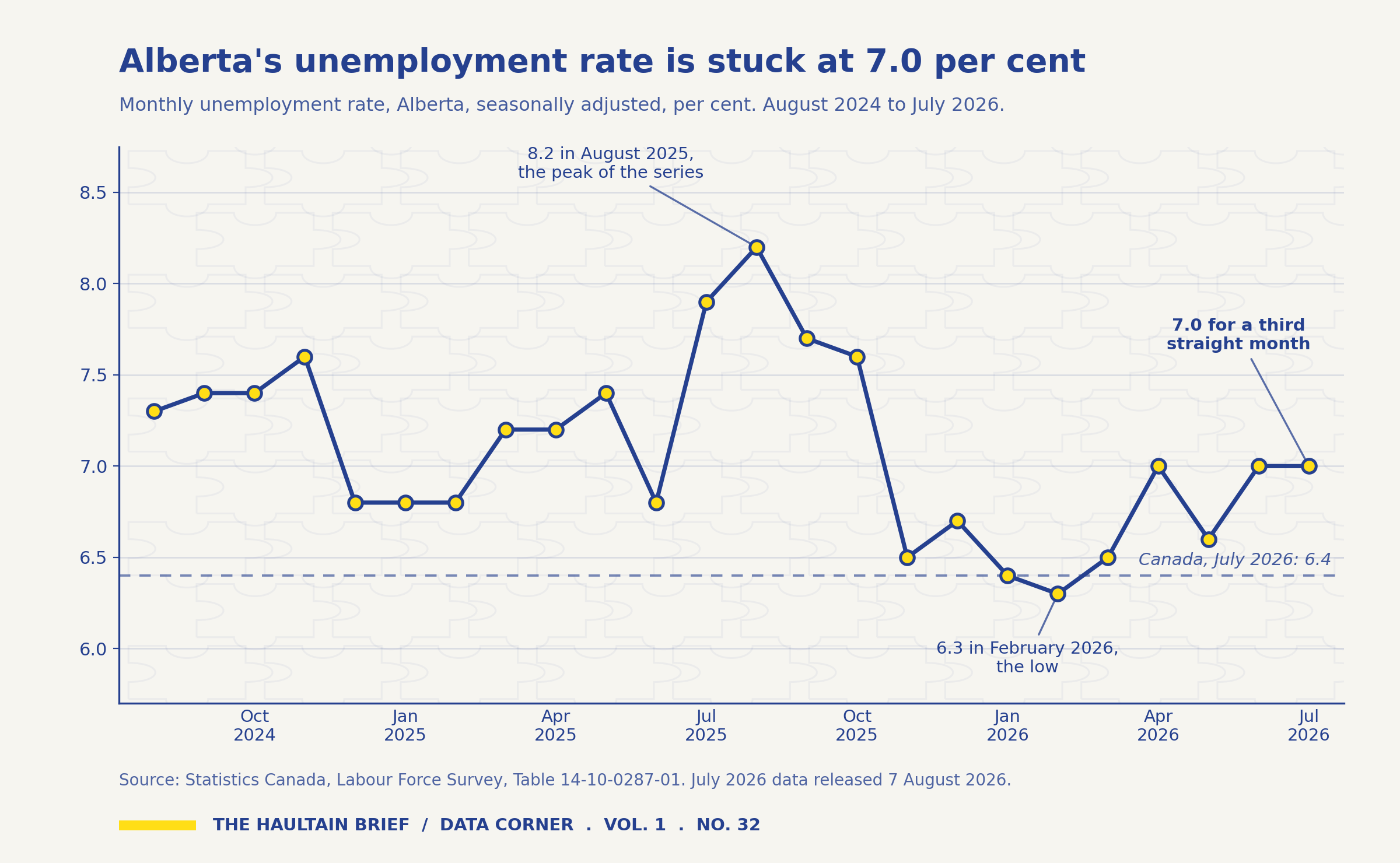
Statistics Canada’s Labour Force Survey, released Friday, is the clearest single picture of the Alberta paradox. Employment in the province is up 91,000 over the year, a gain of 3.5 per cent and the largest proportional increase of any province. And the unemployment rate has not moved: 7.0 per cent in May, 7.0 in June, 7.0 in July. Alberta is now tied with New Brunswick for the second highest unemployment rate in the country, behind Newfoundland and Labrador, and sits 0.6 points above the national 6.4 per cent.
Both facts are true at once because the labour force is growing about as fast as employment is. Alberta is absorbing people faster than any other province and creating jobs faster than any other province, and the two roughly cancel. That is not a failure of job creation; a province adding 91,000 jobs in twelve months is not failing at job creation. It is a statement about the denominator, and it explains why an unemployment rate that would signal a downturn elsewhere coexists here with record corporate profits and severe shortages in trades and health care. It also means the rate is a poor instrument for judging Alberta’s economy, and anyone using the 7.0 figure to argue either that the boom is illusory or that the labour market is tight should be asked which side of the fraction they are talking about.
Source: Statistics Canada, Labour Force Survey, July 2026, released 7 August 2026, Table 14-10-0287-01.
The Take
1. The pipeline will be won or lost on the consultation record, not the Gazette notice.
Designation under the Building Canada Act is a scheduling tool. It shortens the federal process; it does not shorten the Crown’s constitutional obligations, and it cannot immunize the project against judicial review. Northern Gateway had its approval and lost it in the Federal Court of Appeal in 2016 on precisely this ground. The Union of British Columbia Indian Chiefs has now put its objection on the record on the first weekend of the comment period, with the specific complaint that the corridor and the partners were fixed before engagement began. That is the argument that killed the last one, and Alberta is right to be wary of where it leads. This province has watched environmental review turn from a process with an answer into a process without one, and nothing prevents consultation being put to the same use by people whose actual objection is to the oil. The distinction worth holding is between two things now travelling under one word. The Crown owes a real and bounded duty to the Nations whose rights the corridor touches, and a bounded duty can be discharged. The letter that landed Sunday is something else: it is an open letter about wildfires and floods, and its objection is to expanded production as such. That is a policy argument, and it deserves a policy answer, not a procedural one. Alberta’s interest is therefore not a fast designation and not an open-ended one. It is a designation with funded consultation capacity, a defined endpoint and a decision date, so that a record built honestly in 2026 cannot be reopened indefinitely in 2029.
2. The week’s biggest economic number appeared only in the trade press.
Canadian Natural told its shareholders that roughly 340,000 barrels a day of growth projects will not proceed until definitive agreements under the trilateral memorandum with Alberta and Ottawa are finalized, targeted for November. Suncor has signalled it wants similar certainty. This is a rare thing: a direct, company-audited measurement of what unresolved policy costs in barrels, disclosed in the same quarter both companies reported records. It is more informative than any modelled estimate of regulatory burden, and it went almost entirely uncovered outside the Daily Oil Bulletin. If the November deadline slips, that is a quarter of a million barrels a day of deferred investment, and readers should hold both governments to the date.
3. Ottawa is defending the sector that is not the West’s.
United States tariffs of 50 per cent on some Canadian goods take effect 19 August, and the Washington round now turns on what Canada is willing to trade away. The Prime Minister used a stop in Saguenay last week to reaffirm that supply management stays. Dairy Farmers of Canada put its position plainly: “Our food sovereignty is not for sale; a bad deal is not worth the cost.” Nobody in Ottawa said anything comparable about beef, pork, canola or wheat, none of which are protected by statute, all of which sell into export markets, and all of which will absorb whatever tariff survives the round. This is the standing shape of Canadian trade policy: the sector defended by legislation is defended, and the sector that actually earns the foreign exchange is asked to carry the adjustment. At Haultain Research we would rather that trade-off were priced publicly before 19 August than explained after it.
Worth Watching
South Bow signs twenty year commitments out of Hardisty. The Keystone operator secured binding twenty-year commitments from nine customers totalling 465,000 barrels a day of firm service from Hardisty to United States delivery points, a substantial vote of confidence in existing southbound egress. BOE Report, 5 August 2026
British Columbia declares a state of emergency as Alberta stays quiet. Premier David Eby declared a provincial emergency Saturday with 105 active fires and more than 20,000 people evacuated ahead of the Bald Range fire near Summerland. Alberta reported no wildfires of note in its Forest Protection Area. Global News, 8 August 2026
Calgary raises its natural gas franchise fee 37 per cent. The increase is designed to raise $98.2 million and will add roughly $29 a year to a typical household’s bill from 2027, a municipal tax collected through a provincially regulated utility rather than through property assessment. Western Standard, 7 August 2026
The regulator approves a coal mine expansion without a hearing. The Alberta Energy Regulator approved expansion of the Vista coal mine near Hinton, operated by Coalspur Mines Ltd., extending operations more than a decade, without holding a public hearing. Expect a judicial review application. Western Standard, 5 August 2026
Alberta’s crop is well ahead of average but drying in the south. The provincial crop report rated major crops 58 per cent good to excellent against a five year average of 43 per cent, with conditions slipping in the south and centre and sub-surface moisture down six points on the week. Alberta Crop Report via rdnewsnow, 7 August 2026

Published Wednesdays. Follow the links above to primary sources. A Haultain Research publication: www.haultain.org