


The Haultain Brief is a weekly compilation of the news that matters for Alberta and Western Canada. Each Wednesday, we cover the prior week’s political, economic, energy, legal, and institutional developments, organized by theme, with links to primary sources. The editorial perspective will be familiar to Haultain Research readers: evidence-driven, skeptical of fashionable orthodoxies, unapologetically Western Canadian. The Brief complements rather than replaces the longer analytical essays published here. If you find it useful, consider subscribing to support the work.
Economy & Finance
Alberta swings $11.4 billion in a single quarter, and the oil price did all of it
Alberta’s first-quarter update forecasts a $2 billion surplus for 2026-27, an $11.4 billion improvement over the $9.4 billion deficit projected in Budget 2026 in February. Non-renewable resource revenue accounts for $9.7 billion of that swing.
Why it matters: At Haultain Research, we read this as a price report rather than a performance report. Total revenue is now forecast at $86.3 billion on a West Texas Intermediate assumption raised to US$73.50 a barrel from US$60.50, and the province’s sensitivity is that each additional US$1 on the annual average is worth roughly $680 million. The benchmark has averaged about US$88 since April and must hold US$65 through the rest of the fiscal year for the forecast to survive. A treasury that can move eleven billion dollars in one quarter without a single policy decision has a volatility problem, not a management triumph, and the honest test of this update is what gets saved rather than what gets announced.
Sources: Government of Alberta, 27 August 2026; Lethbridge Herald, 28 August 2026.
Saskatchewan books a deficit on the same barrel that put Alberta in surplus
Saskatchewan’s first-quarter report, released the same day, forecasts an $825 million deficit against $819 million at budget. Revenue rose $331 million to $21.7 billion while expenses rose $337 million to $22.6 billion, cancelling out the resource gain entirely.
Why it matters: At Haultain Research, we think the two reports read together are more instructive than either alone. Saskatchewan collected an extra $320 million in non-renewable resource revenue on a West Texas Intermediate assumption of US$75.00 against US$59.75 at budget, and still finished worse than it started because health system demand, compensation, flood response and crop insurance claims from an exceptionally wet spring took slightly more than the windfall delivered. Net debt to GDP nonetheless improved to 14.9 per cent from 16.1 per cent. The lesson for Edmonton is that a commodity windfall only reaches the bottom line if the spending side is held still while it arrives.
Source: Government of Saskatchewan, 27 August 2026.
The national economy grew 0.8 per cent, and the energy sector did the earning
Statistics Canada reported real gross domestic product up 0.8 per cent in the second quarter, led by exports, household spending and business investment. The first quarter was revised up from flat to 0.1 per cent, erasing the reported technical recession.
Why it matters: At Haultain Research, we note the line that got the least attention. Corporate incomes rose 9.6 per cent, the largest quarterly increase since the first quarter of 2021, and Statistics Canada names the energy sector as the top contributor to that gain. Exports rose 3.6 per cent, the largest increase since early 2023. Per capita output rose 1.0 per cent, which the agency attributes partly to a population that has now declined for three consecutive quarters nationally. So the quarter that rescued the national growth numbers was carried by the sector Ottawa has spent a decade constraining, and by an arithmetic effect nobody wants to celebrate out loud.
Source: Statistics Canada, 28 August 2026.
Intergovernmental Affairs
Ottawa publishes its counter tariff list, and Prairie machinery is on it
The Department of Finance published the schedule of Canadian counter tariffs covering $27.6 billion of United States imports at rates of 15, 25 and 50 per cent, effective 12:01 a.m. on 8 September. Named categories include agricultural equipment, pulp and paper.
Why it matters: At Haultain Research, we would separate the politics from the mechanics. A counter tariff is a tax collected from the Canadian buyer, not the American seller, and this one applies to capital goods that Western producers import. The measures apply only to goods eligible to be marked as originating in the United States under the CUSMA marking rules, which means importers must now document origin on thousands of lines before the deadline. The list was also amended the day after publication, with seafood removed and other goods substituted. Two weeks is not long enough for a mid-sized Prairie business to reorganize a supply chain around a moving schedule.
Source: Department of Finance Canada, 25 August 2026.
The premiers cannot agree on weaponizing Western resources
Premier Danielle Smith rejected any tax on Alberta oil exports, saying it “would absolutely devastate the Canadian economy.” Premier Scott Moe refused to restrict potash but imposed a 50 per cent levy on American alcohol. Premier Wab Kinew backed retaliation.
Why it matters: At Haultain Research, we would put the constitutional question plainly. Ontario Premier Doug Ford wants potash exports cut, a measure whose entire cost would fall on Saskatchewan, which supplies more than 86 per cent of the potash the United States buys from Canada. Moe’s objection is not sentiment but arithmetic: a customer forced to source elsewhere does not necessarily come back. Smith struck a cabinet committee co-chaired by her finance and jobs ministers and opened a portal for businesses to report tariff damage. Whatever one makes of the strategy, a federation that lets one province propose sacrifices for another is not negotiating as a country.
Sources: Red Deer Advocate, 26 August 2026; Government of Saskatchewan, 27 August 2026; EnergyNow, 28 August 2026.
Energy & Resource Development
Trans Mountain is running at 94 per cent
Trans Mountain Corporation, the federally owned pipeline company, moved 840,000 barrels a day in the second quarter, 94 per cent of capacity, against 703,000 a year earlier. It remitted $450 million to Ottawa in interest and dividends.
Why it matters: At Haultain Research, we would treat the utilization number as the argument. A line the federal government was told nobody would use is close to full four years after opening, and it earned $808 million of revenue and $138 million of net income in a single quarter. Chief executive Mark Maki said deteriorating trade relations have made a second west coast line “much more urgent,” with a regulatory filing planned for early 2027 and a cost estimated between $35 billion and $44 billion. That is a very large number, and the case for it still rests on shippers committing barrels rather than on ministers committing adjectives.
Sources: EnergyNow, 28 August 2026; BOE Report, 28 August 2026.
Saskatchewan tells data centres to bring their own power
Saskatchewan published a data centre framework requiring new operators to generate their own electricity rather than draw on SaskPower, the provincial utility, with Bell Canada’s existing project the sole exception. Alberta allows large loads to connect before their generation arrives.
Why it matters: At Haultain Research, we regard this as the more defensible of the two designs, and we say so because we have criticized provincial intervention elsewhere. Saskatchewan puts the cost of new demand on the party creating it. Alberta’s bring your own generation rules let a data centre draw from the pool first and build later. The Pembina Institute, a Calgary energy think tank, estimates that Meta’s $13 billion Sturgeon County project could add between $267 and $462 a year to a typical household bill between 2027 and 2031. Whether that estimate holds is contestable. That the risk sits with ratepayers rather than proponents is not.
Sources: Global News, 27 August 2026; Pembina Institute, 26 August 2026.
Keep the Brief coming
The Haultain Brief is compiled by Haultain Research staff and is a reader-supported publication. To receive new posts and support our work, consider becoming a free or paid subscriber. You may also support us by sharing our work with like-minded friends and family, or making a modest donation at www.haultain.org
Business & Investment
Enbridge sells a quarter of its British Columbia gas system to KKR
Enbridge agreed to sell an indirect 29 per cent interest in its Westcoast natural gas system to KKR, the American investment firm, with Apollo as co-investor, for about C$2.7 billion. Enbridge keeps majority ownership and operating control.
Why it matters: At Haultain Research, we read this as a financing decision with a strategic tell. Westcoast runs more than 2,900 kilometres from Fort Nelson in northeast British Columbia and Gordondale on the Alberta border south to the Huntingdon and Sumas crossing, carrying 3.6 billion cubic feet a day and rising to 3.9 once its current expansion enters service in late 2028. Chief financial officer Pat Murray described the deal as a way to “efficiently recycle capital” while advancing growth. Foreign capital is buying minority positions in Western Canadian gas egress because liquefied natural gas exports have made that egress scarce. That signals capacity, not ownership.
Source: Enbridge, 27 August 2026.
Alberta’s technology grants turn person-years into jobs
Alberta awarded $15.1 million to seven Calgary projects on 24 August and $15.7 million to five Edmonton projects the next day, both through the Technology Innovation and Emissions Reduction fund, Alberta’s industrial carbon compliance pot.
Why it matters: At Haultain Research, we apply the same scrutiny to Alberta’s spending as to Ottawa’s, and the arithmetic here rewards a second look. Emissions Reduction Alberta, the agency that pays the money out, says the Calgary projects would generate 463 person-years of employment and the Edmonton projects 504. The government’s own releases on the same two days call those figures more than 460 jobs and more than 500 jobs. A person-year is not a job: 504 person-years is 504 people working a year, or 50 people working ten. Credit where it is due, the agency names every recipient and every dollar, which is more than most granting bodies manage. The unit should survive the trip to the news release.
Sources: Emissions Reduction Alberta, 24 August 2026; Emissions Reduction Alberta, 25 August 2026; Government of Alberta, 25 August 2026.
Agriculture & Agrifood
Alberta drops Water Act approvals for routine work on private cropland
Alberta will remove Water Act approval requirements for cultivating, seeding, spraying, ditching, draining and infilling where the work affects ephemeral water bodies and temporary or seasonal wetlands on private cropland. Water must stay on site and must not harm neighbouring land.
Why it matters: At Haultain Research, we generally favour removing an approval that a landowner needs for routine work on his own field, and Grant Hunter, Minister of Environment and Protected Areas, is right that thousands of dollars and a wait for permission is a poor return on a seeding pass. But this is a wetlands policy change wrapped in a red-tape announcement, and it deserves to be argued as one. The amendments to the Water (Ministerial) Regulation and the Alberta Wetland Policy do not arrive until the fall, and the tile drainage code of practice not until early 2027. Announcing the outcome before publishing the rule inverts the order that makes consultation meaningful.
Sources: Government of Alberta, 28 August 2026; Western Standard, 28 August 2026.
The Prairie harvest is running weeks behind, and the moisture is the reason
Alberta’s major crop harvest stood at 1 per cent complete against five and ten year averages of 7 and 5 per cent. Saskatchewan reached 11 per cent against averages of 25 and 21 per cent. Manitoba was roughly 4 per cent.
Why it matters: At Haultain Research, we would put the delay beside the tariff calendar. Canadian counter tariffs on American agricultural equipment take effect on 8 September, precisely when a late harvest raises the odds that a producer needs a part or a replacement machine in a hurry. Alberta and Ottawa extended AgriStability enrolment to 1 October and lifted the interim payment rate to 75 per cent from 50, which is sensible triage for the northeast where record moisture stopped field work outright. The provincial condition split remains stark, with the North West at 35 per cent good to excellent against a southern region running far better.
Sources: Big West Country, 24 August 2026; Government of Saskatchewan, 27 August 2026; paNOW, 26 August 2026.
Health
Edmonton loses 62 addiction treatment beds, and nobody will say for how long
The Henwood Treatment Centre, the largest provincially run voluntary addiction treatment facility in the Edmonton region, has not operated since late June after overland flooding. Staff were told on 20 August the closure was permanent. Recovery Alberta says it will reopen.
Why it matters: At Haultain Research, we are less troubled by a flooded building than by the absence of a decision anyone will own. Nearly 600 people were on the wait list when Henwood stopped taking applications, for a four-week residential program with waits already running one to four months. Recovery Alberta describes the site as temporarily closed and says it will reopen once repairs are done; staff have told reporters otherwise. A public body that cannot state a reopening date, a cost and a responsible official is failing the accountability test regardless of which account is correct.
Sources: Global News, 25 August 2026; Friends of Medicare, 26 August 2026; Medicine Hat News, 28 August 2026.
Alberta History
April 1936: Alberta’s London bondholders begin asking questions
Alberta’s public finances have drawn international attention before, and not in a flattering way. On 1 April 1936, $3,200,000 of six per cent Alberta government bonds, issued as from 1 April 1921, reached maturity. Of that sum, $2,200,000 had been raised to build the province’s government-owned telephone system and $1,000,000 for general government purposes.
Three weeks later, the matter reached the British House of Commons. Sir Cyril Cobb asked the Secretary of State for Dominion Affairs to establish from the Canadian authorities “the circumstances in which the burden of debt complained of was incurred by the Alberta Government,” and whether the province had invited the loans. Malcolm MacDonald’s reply was short and, for Alberta, unflattering in its plainness: tenders had been asked for in the usual way.
Alberta had gone to the London market voluntarily and on ordinary commercial terms, to string telephone wire across a province during a decade when both settlement and revenue looked permanent. When the Depression arrived, the revenue moved, and the obligations did not. That asymmetry is the oldest fact in Alberta public finance, and this week’s surplus does not repeal it.
Source: UK Parliament, Hansard, House of Commons Debates volume 311, 21 April 1936.
Data Corner
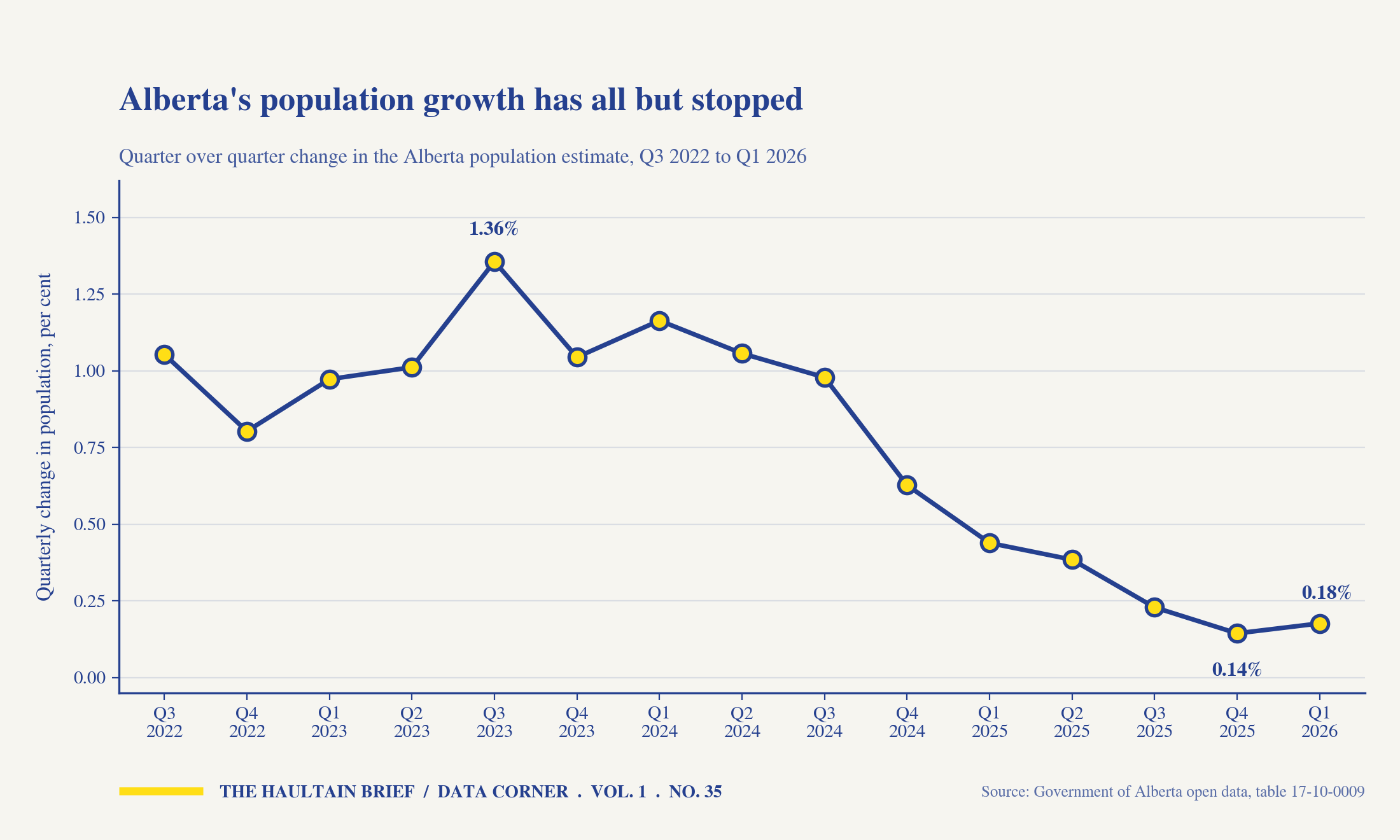
Alberta’s population growth has very nearly stopped. Quarterly growth peaked at 1.36 per cent in the third quarter of 2023, when the province added 63,597 people in three months. It has fallen in every quarter but one since. The province added 7,280 people in the fourth quarter of 2025, a growth rate of 0.14 per cent, and 8,926 in the first quarter of 2026, a rate of 0.18 per cent. That is a decline of roughly seven eighths in two and a half years. Alberta crossed five million residents between the estimates for October 2024 and January 2025 and has added fewer than 70,000 people in the six quarters since.
This counters the fiscal update. The province forecasts real growth of 2.3 per cent in 2026, but with the population flat that growth must come from productivity or from prices rather than from more workers and more households. It also reframes the unemployment rate of 6.6 per cent: a labour force that stops expanding makes a stubborn jobless rate harder to explain away, not easier. Two cautions. These are quarterly estimates dated the first day of each quarter, so the latest reading covers January to March 2026 and was published in June; the next release is due in the autumn. And a slowdown driven by federal immigration policy is a national phenomenon, with the Canadian population falling for three consecutive quarters, not something Edmonton chose.
Sources: Statistics Canada, table 17-10-0009, retrieved via the Government of Alberta economic dashboard, updated 17 June 2026.
The Take
1. The most revealing Alberta number published this week was 2.45 per cent, and almost nobody printed it. Equifax Canada released its second quarter consumer credit report on Monday. Alberta’s ninety-day non-mortgage delinquency rate, measured by dollars owed, was 2.45 per cent against 1.76 per cent nationally; measured by number of accounts, it was 2.15 per cent. Average non-mortgage debt per Albertan was $25,082, and $38,074 in Fort McMurray. To Equifax’s credit, the national story is one of slowing delinquency growth, and Alberta’s own dollar-weighted rate fell slightly over the year. But a province forecasting a $2 billion surplus and 2.3 per cent real growth in the same week is carrying household balance sheets in visibly worse shape than the rest of the country. Treasury prosperity and household prosperity are different series, and only one of them shows up in a mortgage renewal.
2. The cheapest growth policy available to Canada was agreed in Iqaluit, and it cost nothing. Federal, provincial and territorial trade ministers ratified amendments to the Canadian Free Trade Agreement establishing a thirty day service standard for labour mobility applications, committed to an agreement by year end permitting free trade in services across the country, and undertook to reach an agreement in principle on model mutual recognition legislation by the end of the fall. Set that beside the $7.5 billion federal relief package announced the same week. One creates a new fund, a new initiative and a new set of application processes; the other deletes a waiting period. Internal barriers are the one form of protection against Canadian producers that Canadians impose on themselves, and removing them requires no money, no new agency and no American consent. We would rather see this file finished than another envelope opened.
3. Ottawa’s retaliation is loaded onto the goods the West must buy. The counter-tariff schedule names agricultural equipment, pulp and paper, wood, steel, and appliances. No chapter of mineral fuels appears on it. We do not object to leaving energy alone; taxing our own most valuable export would be self-harm, and Premier Smith is right about that much. The objection is to what was chosen instead. A Prairie farmer replacing a combine three weeks into a harvest that is running at a fifth of its normal pace, and a British Columbia mill buying inputs, will pay this tariff themselves, because a counter tariff is collected at the Canadian border from a Canadian buyer. A narrower list aimed at consumer goods with ready domestic substitutes was plainly available and was not taken.
Worth Watching
British Columbia will hold a by-election in Abbotsford-Mission on 26 September, in a seat vacated on 22 August; press coverage reports that BC Conservative leader Kerry-Lynne Findlay, who does not sit in the legislature, intends to run. (BC Gov News, 29 August 2026)
Trade ministers met in Iqaluit and set a thirty-day service standard for labour mobility applications, with an agreement on free trade in services targeted for the end of the year. (BC Gov News, 28 August 2026 and Government of Nova Scotia, 26 August 2026)
Saskatchewan’s rate review panel warned that SaskPower bills could rise as much as 6.4 per cent next February, well above the 3.9 per cent the utility proposed, and deferred its final recommendation until updated financial statements are filed by 2 November. (650 CKOM, 28 August 2026)
More than 7,000 Alberta Safeway workers return to bargaining on 15 September after mediation ended without agreement on a contract that expired a year ago; the union has floated Thanksgiving as a strike date. (The Alberta Worker, 25 August 2026)
Alberta named its second Designated Industrial Zone, roughly 75 square kilometres of the Municipal District of Greenview near Grande Prairie, with no investment figure attached to the announcement. (Government of Alberta, 26 August 2026)

Published Wednesdays. Follow the links above to primary sources. A Haultain Research publication: www.haultain.org
Assume a person works from age 18 to 68... 50 years. Maybe a tad above average, but close enough for my point.
"500 person years" = 10 jobs. They're bragging about opening a Tim Horton's