


Canadians mark a holiday today, named across much of the country for heritage. Alberta calls it Heritage Day; Nova Scotia keeps Natal Day (no relation to the former Boer province, as far as I can tell) in a garrison city the British military founded. A fitting morning to ask why the institution most steeped in our heritage has been ordered to shed it.
On the eleventh day of the eleventh month, chaplains will stand before a cenotaph somewhere in Canada and face a choice no chaplain of the last century faced. The crowd will have just finished singing an anthem that asks G-d to keep our land glorious and free. The ceremony will close, as these ceremonies typically do, with G-d Save the King, a prayer set to music and sung by the whole assembly. Between those two invocations, chaplains, under written orders, may not say what everyone around them is permitted to sing. The word itself has been struck from the order of service by the very institution that sends men and women to die.
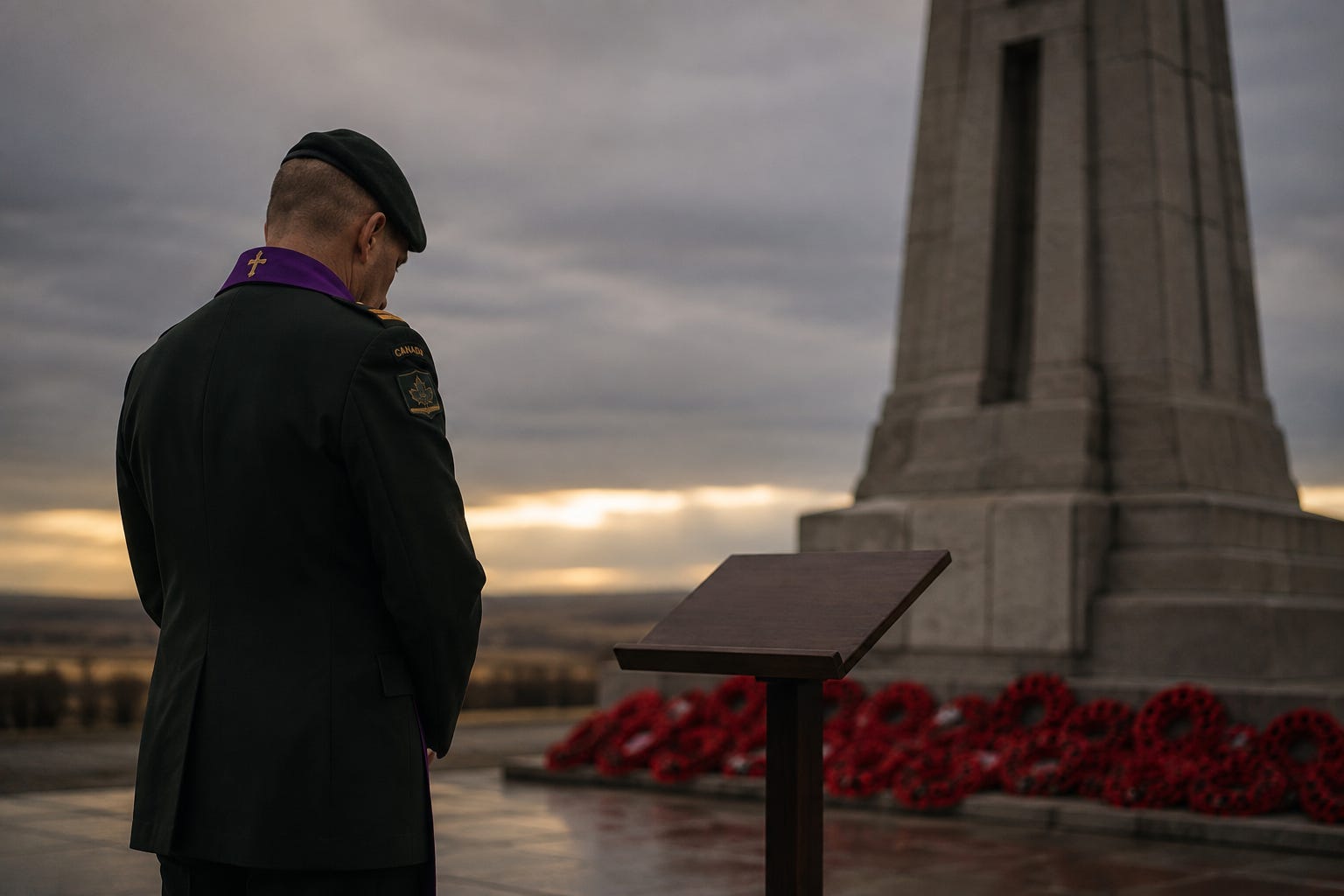
The order is real, recent, and in force. On July 29, the Commander of Military Personnel Command issued Canadian Armed Forces Military Personnel Instruction 03/26, replacing the Chaplain General’s 2023 direction on public prayer. Where the old direction bound only chaplains, the new one binds every member of the Forces, along with defence employees, contractors, students and volunteers who provide spiritual services. Where prayers were once offered at graduation parades, change of command ceremonies, ship commissionings, mess dinners and Remembrance Day, the instruction now requires a “spiritual reflection” instead. The definition is explicit: spiritual reflections use no religious language, and the document names references to G-d as the first example of what must go.
Consider what the instruction does with the prayers our regiments have carried for generations. Section 4.9 permits regimental prayers, graces and patron saints to be taught in a classroom, as history, so that members may learn about them in “an educational context.” Members may study the prayer. They may not say it at the ceremony where it was said for a hundred years. A prayer studied but never spoken is an exhibit. The Canadian Forces have turned their own devotional inheritance into a museum piece and posted a bureaucrat guard at the case.
The profession of arms has never talked the way this instruction talks. The most famous battlefield address in the English language, Shakespeare’s Henry V’s speech at Agincourt, turns on the feast of a saint and on an appeal to Providence: “God’s will! I pray thee, wish not one man more.” Generations of officers have taught it to soldiers; Olivier filmed it in 1944 to steel a nation at war. Strike the saint and strike the prayer and the speech collapses into a staffing complaint about being outnumbered. Soldiers have always been led with the very vocabulary the Forces now forbid.
Neutrality, the document insists, demands all this. Then the document lists its exceptions. Indigenous practices, “some of which contain spiritual elements,” may be included in military settings for cultural, historical and educational purposes, and the instruction assures us that their inclusion endorses no system of belief. Read those clauses side by side, please, and a question forms that the drafters never answer. What principle bars the Naval Prayer at a ship commissioning yet admits “a spiritual” ceremony under an educational label at the same event? The stated principle is state neutrality. The operative principle is the self-induced delusion that one tradition counts as a Charter hazard and another counts as a reconciliation asset. The instruction performs a distinction it cannot defend.
The legal footing is thinner still. The directive rests its authority on a 2015 Supreme Court ruling, Mouvement laïque québécois v. Saguenay, in which a mayor opened municipal council meetings with prayer and the Court found the practice coerced citizens attending a civic assembly.
Chaplains are another matter entirely. The chaplaincy exists because the Canadian state judged, generations ago, that people facing death need spiritual care, or at the very least the freedom to seek it. Stretching a ruling about a praying mayor into a gag on the one office created to pray converts a shield for conscience into a sword against it. No court ordered this. A bureaucrat at a command office chose it.
Six weeks before Ottawa struck God from its ceremonies, Regina heard a different sound. On June 19, the downtown Jamia Masjid broadcast the Islamic call to prayer over rooftop loudspeakers for the first time, three minutes across the city core, under a permit issued by the Regina Police Service through the ordinary noise bylaw process. No council debated it. Threats followed, ugly and real, and the congregation, to its credit, paused the broadcasts on its own and invited the neighbourhood in to talk.
The mosque is not the story. The story sits in the official response: the same police statement that affirmed the permit warned critics that threats would be investigated under Canada’s newly enhanced hate crime provisions. The bylaw served as the broadcast’s shield and, in the same breath, as a sword pointed at its objectors.
Compare the two episodes and the new scaffolding of the progressive Canadian state comes into focus. Inherited western religion is a neutrality problem, to be managed out of public life by directive. New religious expression is a diversity asset, to be permitted, protected and policed on behalf of. Notice who is building the scaffolding. A general’s staff and a police chief’s permit desk now settle, between them, the public standing of G-d in Canada. Parliament was never asked. No bill was tabled, no committee heard a witness, no member rose to speak for the constituents whose ceremonies were being rewritten.
Two uniformed bureaucracies made the decisions, and one of them threatened the citizens about the legal risks of objecting. The decisions arrived the way post-national governance prefers to arrive: as administration.
Remembrance Day does not belong to the military command that now presumes to edit it. The eleventh of November is a civic liturgy, and it belongs to Canadians. The parade itself may be military; the mourning is not. Towns across this country raised their cenotaphs by public subscription after the Great War, and the whole community has gathered at them every November since.
Those of us who pray for our soldiers and remember our fallen know that liturgy by heart: the anthem, the Last Post, the silence, the Act of Remembrance, the prayers, the Royal Anthem. We stand our children in the sleet and cold and teach it to them, exactly as Henry promised his soldiers: “This story shall the good man teach his son.” A tradition kept by the whole people, civilian in practice and in spirit, is not the military’s brass to curtail. The order of service at a cenotaph is a part of the constitution of this country’s culture, the part no command office has authority to amend. An instruction signed by a personnel commander can bind soldiers. A country’s civil memory takes no orders.
When King Charles came to read the Throne Speech, Mr. Carney declared that the gesture “clearly underscores the sovereignty of our country.” The Crown, the anthem, the chaplain’s prayer: one inheritance, all of a piece. The Prime Minister reaches for that inheritance when Washington threatens and would have it managed out of sight the rest of the time.
Mr. Carney asks Canadians to link arms and defend our sovereignty. Let’s give that request a moment of honest examination. Sovereignty defends something. Borders enclose something. Mr. Trudeau announced in 2015 that Canada had no core identity and was the world’s first post-national state; his successor has kept the premise and added a flag to it.
If the traditions that formed this country cannot survive contact with its own military’s ceremonies, and if no shared identity binds citizens to the state, what exactly is the sovereignty we are summoned to defend? Only one candidate remains. The state itself. Sovereign on its own account, its authority untied from any inheritance and undelegated by any people conscious of itself as a people. That is sovereignty as state-worship, and Canadians are being asked to underwrite it with their loyalty.
Modern history has run this experiment a few times, and the results are uniform. Revolutionary France seized the Church, rewrote the clergy into civil servants, and within four years was staging festivals to a state-invented Supreme Being while the guillotine worked. Plutarco Calles’s Mexico closed the churches and unleashed the Cristero war. The Soviet Union built a League of the Militant Godless and a police state to match. Beijing today rewrites scripture through its program of “sinicization” so that every faith preaches the Party first.
The scale differs in each case. The principle never does. Wherever loyalty to the state is asserted as supreme over religious conscience, the arrangement has proven an aberration and, given time, a tyranny. Religious freedom is the canary in liberty’s coal mine because it is the one freedom that names an authority above the state (without the sedition Mr. Carney denounced in February 2022, or the anarchy Chief Justice Wagner decried that spring). Snuff it, and every other freedom becomes a licence the state may revise.
Burke described a society as a partnership between the dead, the living and the unborn. Nowhere is that partnership more literal than in the military, where the living wear the badges of the dead and recite what the dead recited before they became the dead. Men went up Vimy Ridge and into the North Atlantic under those prayers. Strip the prayers from the remembrance, and the partnership dissolves into bureaucratic administration: an HR function with rifles, commemorating sacrifice in language vetted to mean nothing.
A country that turns its back on the traditions of its most tradition-bound institution is turning its back on its own identity. Nobody voted for this. It arrived by instruction and by permit.
An institution or state that permits no G-d above itself has already told you what it worships.
I am not religious but I have no doubt that God is all that is ! Carney wants to think otherwise ! That is his downfall ! His fear mongering and controlling policies will not last. Canadians will find their legs and push back ! We will persevere in the name of God !
"... a staffing complaint about being outnumbered ..."
"... Neutrality ... demands all this ..." Unless, of course one is indigenous.
The problem is that while this sounds like satire - and it certainly does - it is entirely entirely true.
"Only in Canada, you say. Pity."
The first two quotes are, of course, from your column, Sir. The last quote is from an old television commercial for Red Rose Tea but is incredibly apt in the circumstances. One could always choose to purchase or to not purchase Red Rose Tea but a member of the Canadian Forces cannot choose to speak aloud to or about his/her creator.
There are many folks who argue with some cause that "Canada is broken" and there are some folks who respond in the negative to that assertion.
Personally, I keep reading, hearing and seeing more and more, such as that which you detail herein, that causes me to believe that the deniers of that assertion are clearly losing ground.
As always, Sir, thank you for your work.