


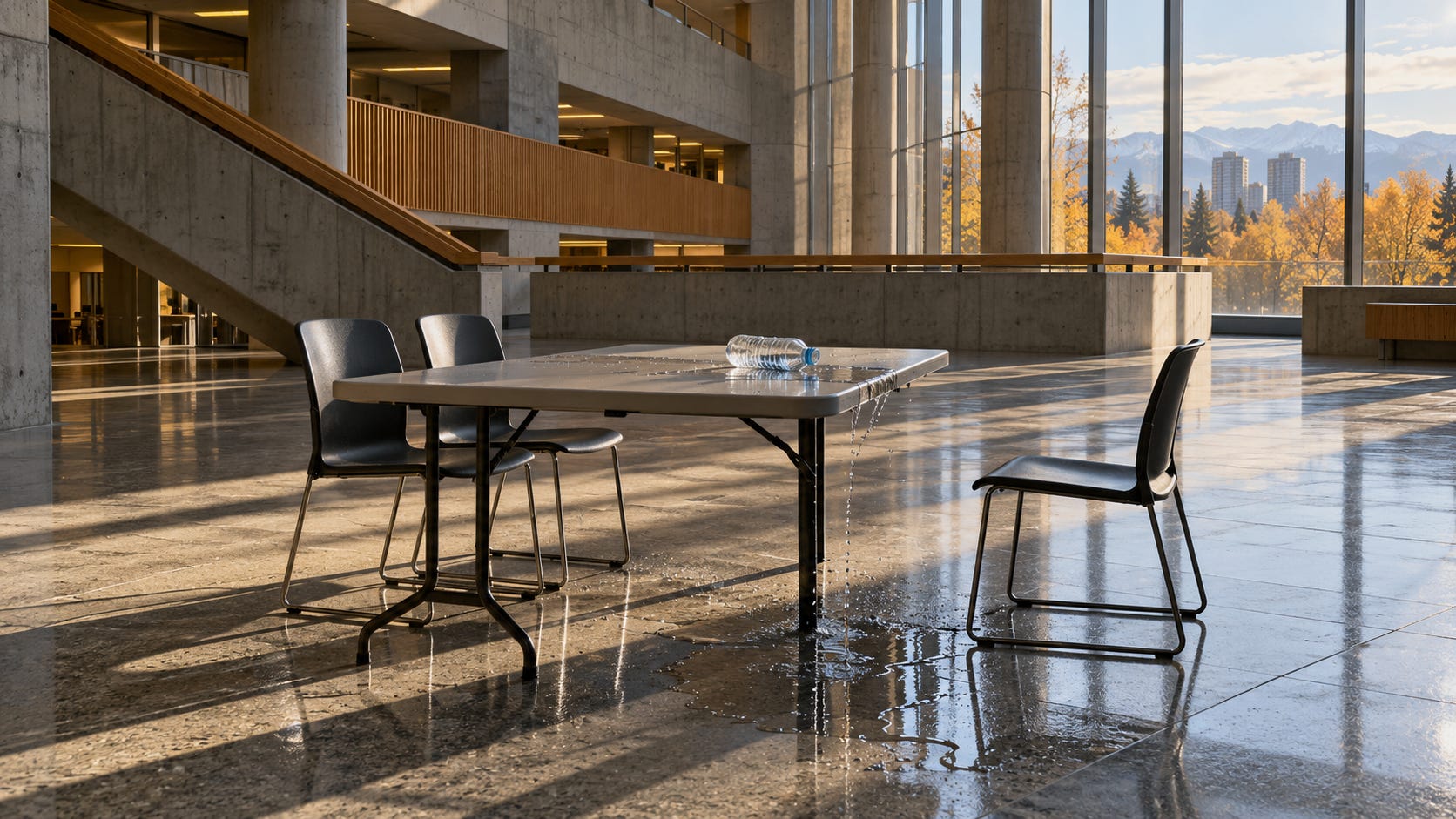
On the afternoon of September 29, an 82-year-old professor emeritus sat at a table in the atrium of the University of Calgary’s Science Theatres and invited any student who disagreed with him to sit down and say so. The question before the table was whether Canada’s residential school system amounted to a genocide. Dr. Tom Flanagan and the Rebel News reporter Drea Humphrey argued that it did not. According to The Democracy Fund, whose team provided security, five or six students took the empty chair, some for more than 20 minutes. Then a crowd gathered, the chant of “get off campus” went up, and a masked figure stepped behind Flanagan unhindered and emptied a bottle of water over his head and onto Humphrey.
A week later, a student told the Calgary Herald that the university had failed in its duty to keep her safe.
Safe from what? The water fell on the elderly professor.
Madison Kelly-Reinhart, a second-year psychology student whom the Herald describes as fourth-generation Métis, helped organize a rally on October 6. She explained her reaction this way: “When I heard that the subject of residential schools being a genocide was being debated and being denied in my school, my safe place, I was furious, and I was heartbroken that our administration could let these denialists set up something so destructive and detrimental to occur in our school.”
The rally of about 50 people pressed four demands: that their university declare the residential schools a genocide, expand its programs for Indigenous students, strip Flanagan of his emeritus title and, according to CP24, bar him from their campus.
Ms. Kelly-Reinhart’s words contain a complete theory of the university.
The theory begins with possession and refuge: “my school, my safe place.” The safety in question has nothing to do with the physical. The only body placed at risk that afternoon belonged to the man Ms. Kelly-Reinhart wants shunned and removed, and her statement does not mention it. Safety, in her vocabulary, means shelter from a proposition. Sadly, she has been conditioned to fear words.
The theory continues by fusing two acts. While to debate a claim is to test it, she hears the test as a negation, so that “debated” and “denied” collapse into one word. Yet the national campus coordinator of Canadian Students for Free Speech, which organized the table, told CTV that “no one is denying that residential schools were an atrocity.” The quarrel concerned the legal name of a documented history, and people are unsurprisingly divided on that question. The Truth and Reconciliation Commission chose the qualified claim “cultural genocide” in 2015 and defined it as “the destruction of those structures and practices that allow the group to continue as a group,” setting it apart from physical genocide, “the mass killing of the members of a targeted group.”
The drafters of the 1948 Genocide Convention voted to exclude cultural genocide from its scope, and in 2015 the International Court of Justice held that the crime requires an intent to destroy a group physically or biologically. On the other side stand the House of Commons, which embarrassingly passed a unanimous motion in October 2022 calling the system it established a genocide; Pope Francis, who carelessly used the word that July; and jurists who read the Convention’s one surviving cultural clause, on “forcibly transferring children of the group to another group,” as decisive. By a standard that treats dissent from a word about something as the denial of a deed about another, the Commission’s own qualifier would count as denial.
The theory ends with permission: “our administration could let.” On this view, speech on campus happens by the administration's leave, whose duty is to approve or deny specific messages.
But the university’s rules say the opposite. Its Statement on Free Expression, adopted in December 2019, gives every member “the freedom to investigate, comment, listen, gather, challenge and critique,” and warns that the right to contest the expression of others “does not extend to efforts to obstruct or prevent the free expression of others.”
The university’s published guidance adds that “the teaching of controversial subjects presents an opportunity to expose students to a wide variety of perspectives, and to provide them with tools to analyze issues and communicate across differences.” Under these rules, the administration has no power to “let” a lawful conversation take place. It has a duty to protect one.
Ms. Kelly-Reinhart did not invent her theory. She likely learned it at the University of Calgary.
For years the university has taught its students two accounts of what a university is, and it has taught them in two registers. The first lives in its rules. The free expression statement came in 2019, after the provincial government directed every Alberta institution to adopt a policy in the spirit of the University of Chicago’s principles. Ironically, politicians needed to remind the self-ruling institution, by directive, of its purpose and obligations.
In June 2025, the Board of Governors added a Position on Statements, which binds the university and its “faculties, departments, councils, offices and other administrative units” and holds that “a university is not one voice, but many. When the institution speaks, it can shrink the space available for the speech of its members.” These documents speak in the cool idiom of governance, and few students ever read them. It wouldn’t hurt to see every academic course outline refer to them.
The second account lives everywhere else, and it speaks in progressive terms that it takes as gospel. The Indigenous strategy of 2017 promises “a welcoming, inclusive and culturally competent campus community.” On the very day Dr. Flanagan sat down at his table, the university’s news service quoted a staff member describing the Writing Symbols Lodge, its Indigenous student centre, as “a home away from home.”
Even the free expression guidance invites students to share their views “in a safe and respectful manner.” A young person who hears the first account only once and the second twice every week will believe the second. She will take the university for a home, a refuge from her prejudices, and she will expect its stewards to keep out whatever disturbs the household.
The university administration embodies the contradiction it taught. Verity Turpin, the vice-provost for student and campus experience, said she was present at the event.
Ms. Turpin is a public relations and e-commerce graduate, with an accounting designation. Her UofC bio says “Turpin held progressive roles at Dalhousie University,” one of the wokest places in Canada.
At a separate gathering the next day, Ms Turpin called the event where Dr. Flanagan was assaulted as “both deeply hurtful and harmful” and said that “we stand with our Indigenous community.”
In remarks reported by CTV, Ms. Turpin went further: “From my heart, the University of Calgary stands firmly with our Indigenous students and our Indigenous community members.”
A week later, the university’s official statement on the rally said what its rules require, in contradiction of its vice provost: “The university does not take a position on the issues expressed, and must permit lawful assembly and expression; irrespective of whether the topics are controversial or uncomfortable. This is the role of a public university.” How embarrassing for Ms. Turpin, whose first name means “truth.” Public relations programs at Mount St. Vincent don’t likely entertain epistemological intricacies.
“From my heart” is the warm language of a private person. “The University of Calgary stands” is institutional language. Ms. Turpin’s sentence fastens the one to the other, and in doing so it crosses the line her Board drew. The Position on Statements lets staff speak to the media about their own experience, provided they attribute their remarks to themselves and don't present them as the university’s position. A vice-provost who declares where “the University of Calgary stands” on a contested event speaks as the institution, and the institution has promised to stay silent on such questions.
The same rules allow the university to speak on matters directly related to its operations. The physical safety of a lawful speaker on its premises is such a matter, perhaps the plainest one. On the assault, the administration has said nothing that any published report records. “The university hasn’t condemned the mob action, which disrupted our event,” Dr. Flanagan told the Herald. In his view, “it really amounts to the university taking a political position, which they’re not supposed to do.”
Ms. Turpin spoke where the University rules avoid speech and kept silent where they permit it.
Alberta’s government has told its universities the same thing three times. In 2019, it directed them to adopt the Chicago-style policies. In September 2025, the Minister of Advanced Education, Myles McDougall, issued a mandate letter instructing him to “assess the need for legislation that protects academic freedom and freedom of expression at postsecondary institutions.” A month later, the province-commissioned expert panel, chaired by economist Jack Mintz, recommended that institutions “remain neutral on issues beyond their mandates” and stated that “it is not open to institutions, or to their senior administrators, to publicly take sides on political questions.”
No Alberta statute yet imposes neutrality on the University of Calgary; its own Board did so in June 2025. A university that cannot keep the rule it wrote for itself invites the legislature to write one for it. Same goes for its administrators.
Yet the contradiction marks slight progress, measured against where the university stood five years ago. On May 31, 2021, President Ed McCauley wrote, in the university’s name, that “last week it was confirmed that 215 Indigenous children were buried outside of a residential school in Kamloops,” and that “children were buried en masse in a place that masqueraded as a schoolyard.” He echoed the Tk’emlúps te Secwépemc announcement, which spoke of a “confirmed loss.”
Ground-penetrating radar had detected anomalies in the soil; the specialist’s report presented that July described 200 “targets of interest” likely to indicate burials. No exhumation has begun. In 2021, the university’s president announced, embarrassingly, in the institution’s voice, as settled fact what no excavation had established. In 2026 the institution’s official statement declines to take a position, Ms Turpin’s PR effort notwithstanding. A university divided against itself has at least recovered half its conscience, which knows what it owes the evidence.
Haultain Research is a reader-supported publication. To receive new posts and support our work, consider becoming a free or paid subscriber. You may also support us by sharing our work with like-minded friends and family, or making a modest donation at www.haultain.org
The Calgary Herald took the student’s theory and gave it its own voice. Its report of the rally told readers that the event “was a painful reminder that Indigenous people are still being forced to defend their history.” The sentence belongs to the reporter, and it settles in the newspaper’s voice the question the event existed to argue.
Nobody was forced into anything at a table in an open atrium; the only force applied that afternoon cowardly came out of a water bottle. The removals, the abuse and the deaths are documented, and they were not in dispute. Deaths are not murders, however: the Commission’s own register records tuberculosis as the dominant reported cause, and no exhumation has confirmed the burials announced at Kamloops in 2021.
What remained in dispute was the legal classification. The same report stated that “a student poured water over Flanagan’s head.” Five days earlier, the university had told LiveWire Calgary that the person was an external party “not affiliated with the university.” The Herald did not tell its readers that the Truth and Reconciliation Commission had chosen a qualified term, or that the two speakers sat at an open table where any student could argue the other side. A newspaper that narrates in a protester’s vocabulary has stopped reporting the argument and joined it. It has a problem like the University’s.
A university exists to do one thing no other institution does as well: to keep contested questions open for the young to learn how to judge them. Its members inherit conversations older than any of them, often older than any one institution, and hand them on, improved if they can manage it.
The scholar who has spent his life in that conversation is the institution’s capital. Dr. Flanagan taught at the University of Calgary from 1968 until 2013. I studied at the University of Calgary, and Flanagan was my MA and PhD Supervisor; I learned much from him, even when he was not teaching. He was elected to the Royal Society of Canada in 1996, won the Donner Prize in 2001 for First Nations? Second Thoughts, and devoted much of his scholarship to Louis Riel and the history of the Métis. He was also active in political life, advising federal and provincial leaders. Students and vice provosts may reject every conclusion he has reached. But a university that bars him from its grounds for reaching them teaches its students something graver than error.
The student demands of October 6 would turn the university into a different kind of institution. A declaration that the residential schools were a genocide would bind, in practice, every historian, anthropologist, lawyer and political scientist on campus, and it would place the university’s authority on one side of a question that the Commission answered with a qualifier and that international law still contests.
Parliament itself, for all its lack of institutional spine, declined in June to punish dissent on the question: the Senate defeated, 41 to 32, an amendment to Bill C-9 that would have made a crime of “condoning, denying or downplaying” the residential school system.
The students ask their university to impose a sanction the Senate refused. Stripping a professor emeritus of his title for arguing the other side would show every untenured scholar which questions are safe to ask. Worse still, an institution that announces its conclusions in advance and punishes those who reach others has stopped educating and started catechizing. Instruction that ignores evidence is indoctrination, whatever the syllabus calls it.
The incident handed the university the best teaching opportunity it could ask for. It could convene in a lecture hall the argument the crowd cut short in the atrium: Dr. Flanagan against the ablest scholar it can find who holds that the residential schools meet the Convention’s definition, with a chair, rules, time for questions and the full protection of campus security. Students on both sides would see what argument looks like when nobody fears it. Ms. Turpin could introduce the evening, in the institution’s voice, as the institution’s proper work. The lesson would cost a room and a few hours.
Students and staff who would have their university adopt an official creed and expel a scholar for dissenting from mere popular opinion have mistaken the place where they study and work. They would be turning the UofC into Mount Royal, the place down Crowchild Trail that turfed Dr. Frances Widdowson for resisting the indigenizing of the place. The mistake can be forgiven in a second-year student. Her university taught it to her, and the people who taught it are old enough to know better.
But do remember that despite Dr. Ed Macaulay and thanks to Edmonton, The University of Calgary has begun to remember what a university is for. It now needs to let its better comms people tell its vice provosts and students.
A brilliant essay is offered for all to consume.
When I was in university (Western/UWO, 1981-1985), there was a psychologist named Philippe Rushton who presented a paper claiming evidence that Asians had higher IQs than Caucasians, and Caucasians higher than Blacks.
A debate was planned in a large lecture hall. Professor Rushton debated David Suzuki, who flew in on his own time to accept the challenge.
Of course, he demolished Professor Rushton’s methodology, his statistical illiteracy, and the ethical and moral shortcomings.
More importantly to a young, budding scholar in the audience, he chastised the entire faculty of the university and its colleges for its collective cowardice and reticence.
“Why did I have to fly out here to accept a debate? Why is there no one here willing to take the challenge?”
“Worse still, an institution that announces its conclusions in advance and punishes those who reach others has stopped educating and started catechizing. Instruction that ignores evidence is indoctrination, whatever the syllabus calls it.”
My, how things have changed, and, yet, remained frighteningly the same.
This is a great essay, friend.
Excellent summary! This sounds like entitled babies and children who have never been taught ethics and truth. (Sadly, this applies to the administration also) How can they know truth and reconciliation when they do not understand the meaning. Obviously, the education system has failed; or maybe the political system has done such an incredible job at brainwashing the youth of today that they can not conceive that they must use their critical thinking skills to separate truth from fiction, using only feelings - only factor in conversations and debates these days. The globalist destruction of homo-sapiens is complete - or is it?? This is where debate happens!
Congrats to all Universities that do not cave in to the brain dead. We need open conversations without being afraid. The masked individual should be charged with assault. That could have been something else besides water!! That person has to be made an example so this never happens again during a conversation or debate!!!