


Fewer than a hundred people gathered at Bridgeland Riverside Community Association Park on Thursday morning, many in Maple Leaf red. The Prime Minister worked the line and shook hands. “I like the red,” he told them. Then he said what he hadn't said for eight months. “Say no to the nine.” Two Alberta Liberal members of Parliament, Eleanor Olszewski and Corey Hogan, stood beside him while he said it.
That evening he spoke to thousands at the Forever Canadian rally. He called leaving, as if anyone was already leaving, a dangerous bluff. He said this is not poker. He told Albertans to vote like Canada depends on it. He did not mention the nine. The CBC reporter covering the rally logged the omission under a four-word heading: No “No to the Nine.”
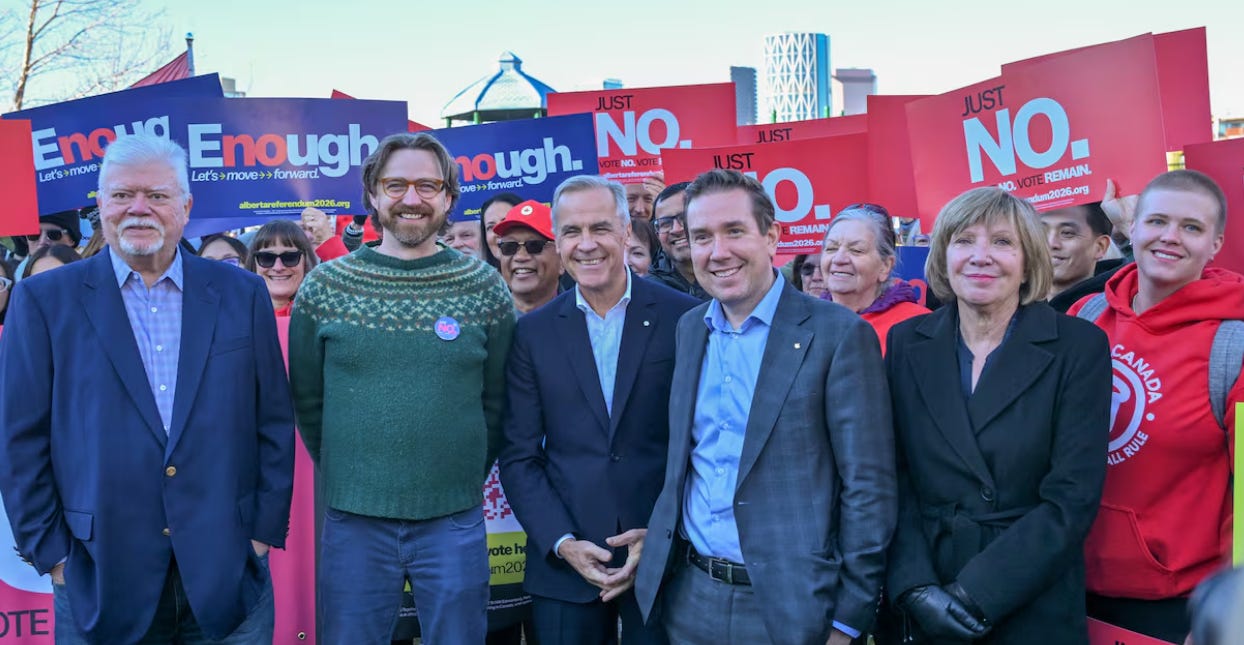
Something happened between the park and the podium. Somebody worked out what the morning line costs.
Consider the eighth question, which is the one that should have given him the longest pause. It asks whether Albertans support their government working with other willing provinces to amend the Constitution so that a province may opt out of federal programs intruding on provincial jurisdiction, in health or education or social services, and keep the associated federal money to spend on its own programs instead.
Read that slowly, please, because a Quebecer would find nothing unusual about it.
Quebec opted out of the Canada Pension Plan before the Canada Pension Plan began. The National Assembly passed its own act on 23 June 1965, and from the first day of 1966 Quebec workers paid into a provincial plan rather than a federal one. Quebec took the surpluses and built the Caisse de dépôt et placement, which became the engine of the Quiet Revolution’s economic ambitions. That province has now run its own pension system for sixty years, and nobody has suggested it threatens the country.
Quebec did the same with hospital insurance in those years, taking sixteen personal income tax points instead of the shared-cost program. It did it again in 2006, when it replaced the federal parental benefit inside its borders with a provincial plan of its own design, after winning the jurisdictional argument and obliging Ottawa to sign.
And Quebec has done the same in immigration since 1991, which matters most this weekend because the federal department that administers it has put it in writing.
Under the Canada-Québec Accord, Ottawa withdrew from settlement services in that province entirely. Quebec selects its own economic immigrants. Quebec sets its own immigration levels, which Ottawa then considers when setting the national plan. For providing the services Ottawa no longer provides there, Quebec receives an annual grant. In 2025 and 2026 that grant was $867,335,000.
Three sentences from Immigration, Refugees and Citizenship Canada’s own briefing material describe how it works. Quebec is the only province that receives such a grant. Under the terms of the Accord, the grant cannot diminish from one year to the next. And Quebec is not accountable to the federal government for how it spends the money. No one in Alberta calls them traitors. No one says they’re racist. No one says they’re outside the Constitution, even though they actually are (since René Lévesque never signed the 1982 bargain).
Read the eighth question again and then read those three sentences again. A province opts out of a federal program in provincial jurisdiction. It keeps the federal money. It runs its own version. The money arrives every year and cannot fall. Nobody audits where it goes.
Question 8 proposes nothing novel. It proposes that any province willing to ask for it should have access to what one province has held for thirty-five years.
Haultain Research is a reader-supported publication. To receive new posts and support our work, consider becoming a free or paid subscriber. You may also support us by sharing our work with like-minded friends and family, or making a modest donation at www.haultain.org
On Thursday, the Prime Minister of Canada travelled to Calgary and told Albertans to vote against that prospect.
He did not argue against it. He did not say the eighth question was badly drafted, or that the amending formula makes it impractical, or that opting out would hollow out national standards. He named no question and engaged none. He gave Albertans four words, and he left the reasoning to the imagination.
The reasoning is not hard to supply, and this is where the damage lies. If opting out with compensation is sound enough for Quebec to practise for six decades across pensions, hospital insurance, parental benefits and immigration, and unsound enough that Albertans should vote it down on Monday, then the principle at work has nothing to do with opting out. The principle is that Quebec may and Alberta may not.
We have a word for that in this country. We call it asymmetry, and a respectable literature defends it as the mechanism that keeps a distinct society inside a federation it might otherwise leave. In 2015, a national party campaigned on a right to opt out of federal programs with full compensation and no conditions, and its senior campaign adviser confirmed that the policy applied to Quebec alone. Nobody called that a threat to the country. Alberta asks for the general version, open to every province, and a prime minister flies in to oppose it four days before the vote.
Notice what Albertans are being taught. Federal governments granted every accommodation on that list to a province with a sovereignty movement, in the years when that movement was strongest, and they understood exactly what they were buying. Jason Kenney, who is campaigning for the same side as Carney, was quoted this week saying that evidence of progress with Ottawa may diminish separatist support. He meant it kindly. Hear it the way an Albertan hears it. Progress is what Ottawa produces when it needs to manage a problem, and the size of the problem determines the size of the progress.
Alberta has spent this campaign doing the opposite of what that lesson recommends. Seventy per cent of Albertans told Leger they intend to stay. The separation question was settled before the Prime Minister’s plane landed. Nine of the ten questions concern how Alberta remains, on what terms, with what standing. A province that is staying asked, through the most public and least threatening instrument available to it, for the arrangements its neighbour already enjoys.
The answer came back as a slogan borrowed from a mercenary campaign strategist.
I am not asking anyone to vote a particular way on Monday. Several of these questions deserve criticism, and some of it has been good criticism. The first question bundles four propositions into a single yes. The seventh needs the unanimous consent of Parliament and ten legislatures, which nobody should pretend a referendum shortens. The ninth asks for something no province has ever held. These notions compel us to read the questions and understand what we are being asked.
The eighth is not in that category. The eighth asks for something that exists, works, is paid for annually by Ottawa, and is not audited by Ottawa. Albertans may well vote it down. Before they do, they should understand that a Prime Minister came to their province and told them to want less than Quebec has, and he couldn't bring himself to repeat it that same evening in front of a larger crowd.