


In 2017, a candidate for Calgary city council filled out a candidate survey for the Canadian Taxpayers Federation. Asked whether he supported “reviewing city services and exploring activities that could be contracted out to save taxpayers money,” he answered: “Government has grown too much and too fast.” He went on: “Every municipal business unit should be open for privatization, with unions openly competing with private firms to keep service delivery in-house.”
The candidate was Jeromy Farkas, then running in Ward 11. He is now mayor of Calgary, and his council is preparing Calgarians for the steepest tax increases in a generation. After a closed session on July 28, council voted 8 to 7 to have administration fit next year’s spending requests within a 15 per cent property tax increase. Farkas was not among the seven who voted no.
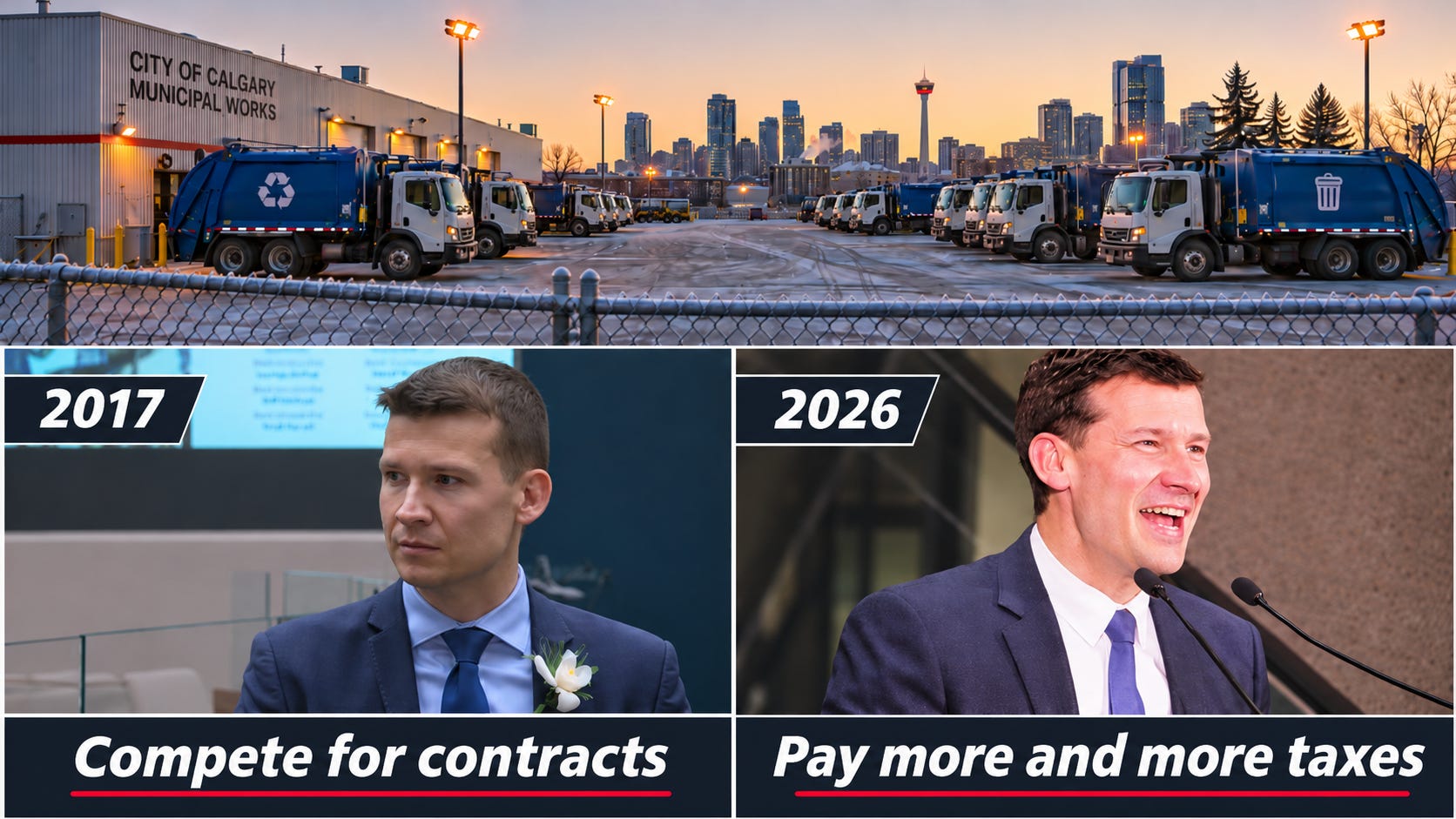
What Farkas indirectly described in his response to the CTF survey is the Indianapolis model. He understands the model, and he once advocated for Calgary to embrace it.
Stephen Goldsmith, mayor of Indianapolis from 1992 to 1999, built a city government on the rule that he called the Yellow Pages test: where roughly three companies in the directory sell a service, the city’s own department must compete for the work. “Everything can be sold or subjected to competition,” he said, “except police and fire services.”
Reviewing the record in 2006, Voice of San Diego found that Goldsmith cut the city’s non-public-safety workforce by 42 per cent in his first term and saved between $200 million and $400 million, helping finance bonds for roads and parks and lower taxes slightly. When city departments chose to bid, savings averaged 25 per cent, and public employees won or shared nearly half of the first 64 competitions.
Calgary under Mayor Farkas is travelling in the opposite direction. The proposed 2027 to 2030 budget would raise municipal property taxes by 15 per cent in 2027, then by 10, 7.7 and six per cent, and lift the operating budget from $5.9 billion to $7.8 billion by 2030. A typical home would pay $37 more a month in property tax in 2027 and $16 more for water, waste and recycling. The 2027 increase would be the largest in a single year in at least three decades. Farkas’s proposals come amid a national affordability crisis.
Farkas calls the hike proposal a starting point, and the Fraser Institute reports that he has defended the increases as necessary for “maintaining the service levels Calgarians expect.” His case has some substance. Calgary is one of the fastest-growing cities in the country. Police, fire and transit all want more officers, stations and buses. The province receives about 42 cents of every residential property-tax dollar Calgary collects, a point Farkas has made repeatedly. The Bearspaw feeder main ruptured in June 2024 and again in December 2025, and someone must pay for maintenance that was put off for decades. Naheeed Nenshi has exonerated himself, but most Calgarians know better.
While Farkas’s points about maintaining services are sound, none of them explains why the city must deliver every service itself, at whatever price its own growing departments name. Growth raises demand, and that’s fair. Who supplies the service, and at what cost, remains a choice for council. It remains a choice for the mayor, should he remember his words from nearly a decade ago.
Calgary’s budget supplies the yardstick: every $28 million in spending equals one per cent on the property tax. Holding taxes flat in 2027 requires about $420 million less than proposed; a five per cent cut requires about $560 million less. Against an operating budget of roughly $6 billion, that means spending seven to nine per cent less than the proposal. The question for the mayor and council is how much of that $6 billion it is willing to put out to bid.
Finding $420 million takes imagination more than austerity. Farkas used to have imagination. The mayor and council should treat every department’s budget as an open question, put services out to bid, invite staff and outside firms to propose cheaper ways to do the same work, at the same or better quality level, and reward the managers who find them by extending their own job contracts. A 15 per cent increase is what a council produces when it stops asking those questions (keep reading below).
Haultain Research is a reader-supported publication. To receive new posts and support our work, consider becoming a free or paid subscriber. You may also support us by sharing our work with like-minded friends and family, or making a modest donation at www.haultain.org
Competition begins with the payroll. City administration grew by 2,268 people in less than two years, from December 2022 to September 2024, an increase of nearly 17 per cent to 15,751 employees. In 2026, the city raised every director’s pay band to a maximum of $290,700. Goldsmith’s competitions shrank payrolls because every bidder had to price labour honestly. A hiring freeze outside police and fire, with attrition doing the work, would put Calgary on the same road, if the mayor had the courage to stand by his earlier convictions.
Recycling is a plain Yellow Pages case. Since April 2025, packaging producers have paid most of the cost through Circular Materials, which runs Alberta’s recycling system on their behalf, and GFL Environmental owns and operates the sorting plant. The city keeps the carts, the crews and more than 100 recycling trucks as the producers’ contracted collector. It also sells commercial garbage, recycling and compost collection to businesses, which are free to hire any of the private haulers listed in the city’s own directory. Provincial rules let a municipality step aside, after which Circular Materials contracts a collector directly.
Toronto went through that change on Jan. 1, 2026, under Ontario’s producer-responsibility rules. The first week went badly: Circular Materials missed post-holiday pickups in parts of two districts, and Premier Doug Ford put the missed stops at roughly 2,000. Crews cleared the backlog within the week, and city staff reported steady improvement through January. Toronto’s solid waste chief expects to save about $10 million a year, which he says will offset rate increases. Calgary should sell the fleet, close the commercial line and leave recycling to the firms that already do it.
Goldsmith also understood that a city need not run every program it funds. His Front Porch Alliance, launched in 1997, matched churches and neighbourhood groups with government resources and expertise. Calgary could do the same with programs: start by offering half of what it now spends to charities, congregations, and clubs that already run children’s camps, and stop running its own. The city has a strong philanthropic DNA and volunteer ethic, and Calgarians will step up.
Competition also changes what failure costs managers. The independent panel on the Bearspaw rupture traced the 2024 break to decades of disorganized leadership that delayed maintenance, and found the city had known of problems since 2004. While the buck stops with the mayor, staff must also bear responsibility for such a lack of organization and internal leadership. Calgarians are paying for it: monthly utility charges on a typical home are projected to rise from $140 in 2026 to $234 in 2030. The City of Calgary should replace the remaining managers who presided over that record and put maintenance under contracts with penalties for failure.
Rules and programs need the same discipline, and their cost matters more than their number. When Gordon Campbell’s new government took office in British Columbia in 2001, it set a rule: for every new regulatory requirement, at least two old ones had to go. By 2004 the province had cut its rules by 37 per cent, and by 2017 by 48 per cent. Ottawa’s one-for-one rule, in law since 2015, counts dollars as well: every dollar of new paperwork cost a federal regulation imposes on business must be offset by a dollar removed elsewhere. Calgary council has more than 107 requests for new or expanded funding before it. A bylaw that retires an existing program or regulation of equal or greater cost for each new one would force council to rank its priorities before it spends, and would save more money.
Savings also need somewhere specific to go. In the 2026 budget, council lowered the tax increase and then spent reserves on new one-time projects. Goldsmith put his savings into roads, parks and lower taxes. Calgary’s budget bylaw should require that any year-end surplus reduce the following year’s tax rate, so that efficiency produces surpluses and surpluses produce tax relief.
Promises to taxpayer groups carry no legal force, Farkas might say. In June 2020, while running for the Conservative leadership, Erin O’Toole signed the Canadian Taxpayers Federation’s pledge: “I, Erin O’Toole promise that, if elected (sic) Prime Minister of Canada, I will: Immediately repeal the Trudeau carbon tax; and reject any future national carbon tax or cap-and-trade scheme.” On April 15, 2021, O’Toole released a climate plan with a carbon price on consumer fuel of $20 a tonne, rising to $50, and insisted it was no tax. MP Bob Benzen listed that reversal first among his reasons for seeking a review of O’Toole’s leadership, and caucus removed him in February 2022.
A survey answer binds a mayor no more than a pledge binds a party leader. Yet, voters may still expect a politician to do what he told them he would do. Farkas has kept such a promise before: as a councillor he said he would refuse his council pension, and he did. It will be up to Calgarians to hold the mayor accountable and not accept the lazy approach of raising taxes by record amounts.
It was a different time, and Farkas made those commitments as a candidate for council, some will say. As mayor, he is paid $226,842 a year—about $30,000 more than Premier Danielle Smith—and has far more power to carry them out than he did as a rookie councillor. Let’s bring back the expectation that he is a man of action, innovation and integrity. If we believe what Farkas tells us about the strain on the city’s finances, the Indianapolis model he once hinted at is needed more now than it was nearly a decade ago.
Before council asks Calgarians for 15 per cent more, the mayor can ask council to open every municipal business unit to competition, as the candidate proposed in 2017.
Now is the time to start this debate. Before council makes its decisions, call your city councillor and the mayor’s office. Read them the mayor’s own words from 2017. Public submissions on the budget begin Nov. 23, and you can register to speak to council or send written comments at calgary.ca/budget. Demand more effort and creativity. Spread the word and share this post with your property-owning and taxpaying Calgary friends.
The caption on the photos of Farkas…I think the one on the right should say 2026.
Superb article though.
Insightful and thought provoking as always, Dr. MNG! A short book by Ludwig von Mises titled Bureaucracy gives analysis on the forces behind the outcomes you describe here. Whenever revenue is coerced and failures shielded from consequences we see what is unfolding now.